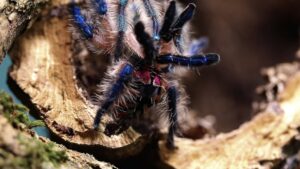
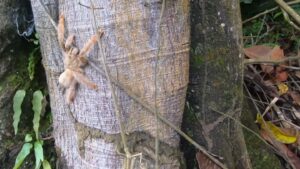
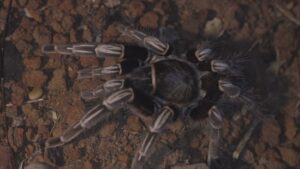
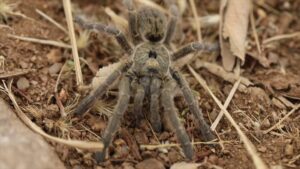
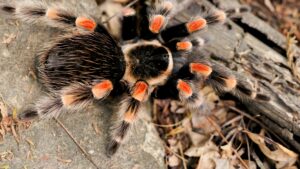
A trapdoor spider lives in a silk-lined burrow and closes it with a hinged lid. Most trapdoor spiders are not tarantulas: they belong to other families of the same large group, the Mygalomorphae, and the lid has evolved several times.1 A few tarantulas do build lids as well, and I have filmed one, the Brazilian jewel tarantula Typhochlaena seladonia. The oldest kind I have met is Liphistius, which we found in Malaysia in 2018 and which is not a mygalomorph at all.
What is a trapdoor spider?
“Trapdoor spider” is a name for a way of living, not for one group. A 2023 study defines a trapdoor as an entrance closed by a door that is an asymmetrical extension of the burrow lining, often mixed with soil or plant fragments, so that one side of the burrow becomes the hinge.1 Across the Mygalomorphae, that study finds, burrows with a trapdoor have evolved several times and have also been lost several times.1 So the name covers families that are only distantly related.
Family placements and genus counts below follow the World Spider Catalog.3
| Family (WSC) | Genera / species | Example genera and where | Have I met it? |
|---|---|---|---|
| Liphistiidae (Mesothelae) | 8 / 199 | Liphistius, South-East Asia | Yes, in Malaysia, 2018 |
| Halonoproctidae | 6 / 150 | Ummidia, Conothele, Latouchia (Latouchia only in Asia) | No |
| Ctenizidae | 2 / 6 | Cteniza | No |
| Euctenizidae | 8 / 79 | Aptostichus, California coast | No |
| Idiopidae | 23 / 455 | Euoplos, Australia | No |
| Migidae | 11 / 108 | Migas; short nests, often on tree trunks | No |
| Stasimopidae | 1 / 56 | Stasimopus, southern Africa | No |
| Theraphosidae (tarantulas), only a few lid builders | 192 / 1,209 for the whole family | Typhochlaena (Brazil), Idiothele (southern Africa), Phlogiodes (India) | Yes, Typhochlaena in captivity |
Older lists of trapdoor families also name Cyrtaucheniidae, Nemesiidae and Barychelidae.2 Family limits have moved a lot in recent years, which is why the same spider can sit in different families in different sources. The Chilean spider further down is a good example.
Are trapdoor spiders tarantulas?
Not the typical ones. Tarantulas are the family Theraphosidae, and they are mygalomorphs, so they are relatives. But most tarantula burrows have an open entrance, and the ancestor of the tarantulas was probably a burrower with an open hole.1 In the tarantula family the lid is the exception, not the rule.
Besides Typhochlaena, which is Brazilian and comes next, I know two more tarantula genera with lids from the literature. Idiothele from southern Africa can seal its burrow with a thin, wafer-like silken trapdoor, although this is not always obvious in the field.5 Phlogiodes validus was described by Pocock in 1899 under that name, was later placed in Haploclastus and was restored to Phlogiodes in 2013.9 When the authors of the 2011 study found it, they first took it for a trapdoor spider of the family Ctenizidae because of its burrow, until they examined the animals and found a tarantula.6
The tarantula that builds a lid: Typhochlaena
The World Spider Catalog accepts six species of Typhochlaena, all from Brazil.3 I keep T. seladonia. In a piece of cork bark she builds her retreat, covers the lid with the same material and closes it from inside, and she uses the fourth pair of legs, the hind legs, to pull the lid shut. In this short you see it, with a female feeding on a cricket that is almost her own size.
In the longer feeding film I hold the lid of this arboreal trapdoor spider open with a pin so that it cannot close completely (0:44), and I show how she silks bark pieces together so that the lid looks like the original bark (7:55). In the wild you would hardly find her, because the trapdoors make the animals hard to spot (2:38). After mating she is completely camouflaged again (6:23).

The wild lifestyle comes from the 2018 paper Christian Andre and I published.2 Twelve weeks in the field in Brazil went into it, all of them Christian Andre’s. Each retreat is flattened against the trunk or set in a shallow depression of the bark, either a simple trapdoor or a short silk tube with a door at one end. Hinged, thin and roughly D-shaped, the door has a thickened silken stop and is built from bark particles taken from the spot. Only 10 to 20 percent of the retreats found were inhabited, and those were closed. Spiders from 5 to 21 millimeters in body length already showed the behavior. A comparison with this lifestyle part of the Migidae, the tree-trapdoor spiders, is in the paper too, though cladistic research does not suggest a close relationship.2 The full story of the genus is on our page about Typhochlaena, Brazil’s jewel trapdoor tarantulas.

The oldest trapdoor spider I have seen: Liphistius
Episode five of our 2018 Malaysia series shows a Liphistius burrow in the forest. Liphistiidae sit in the group Mesothelae, the sister group to all other spiders. They are really old, and a segmented abdomen is one sign of it, which no other spider has. The door does not look like the usual trapdoor, because silk lines run out in front of the entrance. Whenever a small insect touches one of these lines, the spider comes out immediately, knows exactly where the prey was and attacks it (0:32). Not a tarantula, and not even a mygalomorph: that is the spider in the film. The other Malaysia episodes are on our page about wild tarantulas of Malaysia and Thailand.
The 2023 study describes the same trick for lid builders in general: some trapdoor spiders do not strike at prey unless it touches the entrance or comes within millimeters of it, and many build radiating silk or twig lines to widen the area they can sense.1
Lids in Chile: a colony without one
In the 2018 Chile series we found a colony of a spider that looks a lot like a small tarantula. It sat under rocks in a pine and oak forest in the O’Higgins region (1:48). In the snow episode we found a second, different-looking form with a rather big web under a rock and no trapdoor at all (1:04). We could not identify either of them, so for now both are Acanthogonatus sp.

On the family, my own two films disagree: Barychelidae in the first, Nemesiidae in the second. The World Spider Catalog explains why both turn up: Acanthogonatus was moved from the Barychelidae to the Nemesiidae by Raven in 1985 and to the Pycnothelidae by Opatova and colleagues in 2020, and it is the Pycnothelidae today.3 The catalog also notes that the genus is most likely polyphyletic. The video description says “Acanthognathus”, which is not a spider genus; the correct spelling is Acanthogonatus. The Chilean tarantulas themselves are on our page about Chilean tarantulas in the wild, and the snow trip is in tarantulas in snow and at high altitude.

A lid that is only a flap: Davus
Not every lid is a proper door. My lecture about our Panama trip shows the dwarf tarantulas of the genus Davus. Davus fasciatus, which we found there, showed no open burrows, so it looks like they build a trapdoor-like structure, like Davus ruficeps does (54:42). That is not as sophisticated as the lid of Typhochlaena. When I kept D. ruficeps, which I found in Nicaragua in 2013, I think, they built a flap hanging above the entrance, not a real trapdoor (1:00:59). The World Spider Catalog lists D. fasciatus from Costa Rica and Panama and D. ruficeps from Costa Rica and Nicaragua, and treats the later name Metriopelma zebratum (Banks, 1909) as a junior synonym of D. ruficeps (Simon, 1891).3 More about that trip is on our Panama field notes.
Where do trapdoor spiders live?
Several continents, and not the same kind of place. The study I use finds that in families containing both lid builders and spiders with open burrows, the lid builders are often the ones that spread into dry country, for example in the Australian Idiopidae and the North American genera Apomastus and Aptostichus. Nests, short retreats, often with a trapdoor at each end, mostly occur in damper habitats, for example in the Migidae, and they are often built off the ground on tree trunks.1 Stasimopus is endemic to South Africa,7 and Latouchia lives only in Asia.8 I know these from the papers only; my own lids were in Brazil, Malaysia, Chile and Central America.
Are trapdoor spiders dangerous?
I have no bite of my own to report. Doctors in Australia followed 49 bites by mygalomorph spiders with expert identification. Twenty were by trapdoor spiders of the families Idiopidae and Nemesiidae, as those families were named then, and the authors write that true trapdoor spider bites caused only minor effects. The funnel-web spiders in the same study are a different matter: 16 bites, two of them severe enough to need antivenom.4 Funnel-web spiders are not trapdoor spiders, but they also live in burrows, so in Australia a burrow spider is not a reason to pick it up.
For tarantulas on this site, see the Theraphosidae overview, and for what the ones we film in captivity eat, what do tarantulas eat. The burrows we found in the field are collected in fossorial tarantulas: what wild burrows show.
References
- Wilson, J. D., Bond, J. E., Harvey, M. S., Ramírez, M. J. & Rix, M. G. (2023). Correlation with a limited set of behavioral niches explains the convergence of somatic morphology in mygalomorph spiders. Ecology and Evolution 13(9). doi:10.1002/ece3.9706
- Andre, C. & Hüsser, M. (2018). About trapdoors and bridges: new insights in the little-known ecology and lifestyle of the genus Typhochlaena C. L. Koch, 1850. Journal of the British Tarantula Society 32(3): 3-29.
- World Spider Catalog (2026). Natural History Museum Bern, wsc.nmbe.ch, families list, genus pages Typhochlaena, Davus, Acanthogonatus, Idiothele, Haploclastus; accessed 2 October 2026.
- Isbister, G. K. & Gray, M. R. (2004). Bites by Australian mygalomorph spiders (Araneae, Mygalomorphae), including funnel-web spiders (Atracinae) and mouse spiders (Actinopodidae: Missulena spp). Toxicon 43: 133-140.
- Gallon, R. C. (2010). On some Southern African Harpactirinae, with notes on the eumenophorines Pelinobius muticus Karsch, 1885 and Monocentropella Strand, 1907 (Araneae, Theraphosidae). Bulletin of the British Arachnological Society 15(2): 29-48.
- Mirza, Z. A., Sanap, R. V. & Siliwal, M. (2011). Robust Trapdoor Tarantula Haploclastus validus Pocock, 1899: notes on taxonomy, distribution and natural history (Araneae: Theraphosidae: Thrigmopoeinae). Journal of Threatened Taxa 3(10): 2109-2119.
- Brandt, S., Lyle, R. & Sole, C. (2024). The phylogeography and diversification of an endemic trapdoor spider genus, Stasimopus Simon 1892 (Araneae, Mygalomorphae, Stasimopidae) in the Karoo, South Africa. Ecology and Evolution 14(11): e70621.
- Xiong, Y., Li, D. & Xu, X. (2025). Five new species of the trapdoor spider genus Latouchia Pocock, 1901 (Araneae, Halonoproctidae) from China. ZooKeys 1265: 103-127.
- Mirza, Z. A. & Sanap, R. V. (2013). Revalidation of the tarantula genus Phlogiodes Pocock, 1899 (Araneae: Theraphosidae: Thrigmopoeinae). Indian Journal of Arachnology 2(2): 17-21.