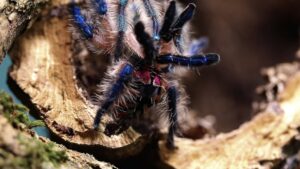
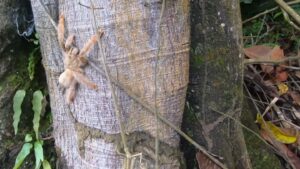
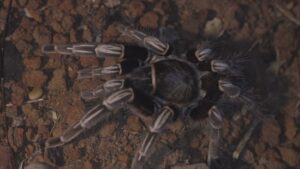
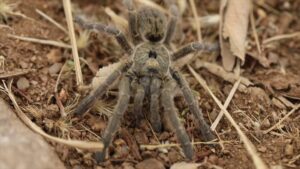
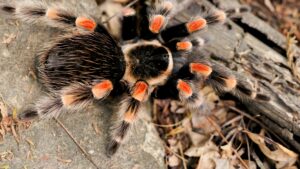
Tarantulas are sorted three ways: by continent (New World or Old World), by how they live (in a burrow, on the ground or in a tree) and by subfamily. All of them belong to one family, the Theraphosidae, which the World Spider Catalog counts at 1,209 species in 192 genera.1 Most authors recognize 12 or 13 subfamilies, and five of them occur in the New World.2 This is how I sort the tarantulas I have found, with a page for each.

What are the main types of tarantulas?
| Way of sorting | The types | What decides it |
|---|---|---|
| Continent | New World and Old World | Where the genus lives. The split also tracks urticating hairs, see Old World vs New World tarantulas |
| Lifestyle | Burrowing, terrestrial, arboreal | The family includes burrowing, terrestrial and arboreal taxa2 |
| Subfamily | 12 or 13 in current classifications | Anatomy and, since 2018, DNA2,3 |
None of these three is a clean box. Genera move between subfamilies when new DNA data arrives, and one animal can be a burrower as a juvenile and live in a tree later.
How many tarantula species are there?
The catalog lists 1,209 species in 192 genera in version 27, with the family row last updated on 27 November 2025.1 In 2017 Lüddecke and colleagues counted 962 nominal species in the family, so the number has grown by about a quarter in eight years.3 The largest subfamily, Theraphosinae, holds about half of the known species.2 The numbers keep moving because new species and new genera appear every year, and I follow that on our overview of the Theraphosidae.
Are there Old World and New World tarantulas?
Yes. The New World has five subfamilies in the classification Pérez-Miles follows: Aviculariinae, Ischnocolinae, Psalmopoeinae, Schismatothelinae and Theraphosinae.2 The rest of the subfamilies are African, Asian or Australasian, and the table below gives their ranges.3 What that means for hairs, defence and venom is on the page about Old World vs New World tarantulas.
Which tarantulas live in burrows, on the ground or in trees?
The family includes burrowing, terrestrial and arboreal species.2 In the key Pérez-Miles gives for the New World, most species of Aviculariinae are arboreal.2 The kind I know best from the field is the burrower. In Costa Rica I walked a dry road bank where the typical burrow of Aphonopelma seemanni has leaf litter worked into a silked entrance (3:05). We came back at night and tickled an adult female out of a burrow (6:43). Reto blocked the tunnel behind her with forceps so we could film, and afterwards she went back into the same burrow (8:43).

Where the wild burrows are and what they look like is on fossorial tarantulas; the silk side, including tree retreats, is on do tarantulas make webs.
Which subfamilies are there, and which have I filmed?
The table follows Table 1 of Lüddecke and colleagues, which uses the World Spider Catalog classification of 2017.3 The catalog’s genus list does not sort genera into subfamilies, and later work moved some genera, for example Psalmopoeus, which sits in Aviculariinae in 2017 and in Psalmopoeinae in the key Pérez-Miles gives.2,3 The species counts are the 2017 ones. Since then my 2018 paper diagnosed Psalmopoeinae, with Psalmopoeus, Tapinauchenius, Pseudoclamoris and Ephebopus.4 The transcriptome study of Foley and colleagues (2019) supported Psalmopoeinae and Poecilotheriinae, found Ischnocolinae not monophyletic, and placed Aviculariinae, Schismatothelinae and Theraphosinae together in one New World clade.5
| Subfamily (2017) | Range | Species in 2017 | What I have found |
|---|---|---|---|
| Theraphosinae | North America (USA, Mexico), Caribbean, Central and South America | 489 | Aphonopelma, Brachypelma, Grammostola, Sericopelma, Xenesthis, Nhandu |
| Aviculariinae | Mexico, Caribbean, Central and South America | 86 | Caribena, Avicularia, Psalmopoeus |
| Eumenophorinae | West and East Africa, Madagascar, Yemen, Indian Ocean islands, India | 64 | Pelinobius, Monocentropus, Hysterocrates |
| Harpactirinae | Central and Southern Africa | 61 | baboon spiders: Harpactira, Ceratogyrus |
| Stromatopelminae | West and Central Africa | 10 | Heteroscodra |
| Ornithoctoninae | South-East Asia | 27 | Omothymus, Malaysia and Thailand trip |
| Selenocosmiinae | Indian subcontinent, South-East Asia, Australasia | 123 | Coremiocnemis, Chilobrachys on the Malaysia and Thailand trip; Poecilotheria (the 2018 results support it as its own subfamily, Poecilotheriinae) |
| Ischnocolinae | Africa, Asia, Europe, Caribbean, Central and South America | 86 | Ischnocolus; the table marks this group as likely polyphyletic |
| Schismatothelinae, Selenogyrinae, Thrigmopoeinae | South America; West Africa; Indian subcontinent | 13, 7, 10 | none yet |
Do common names tell me the type?
Not reliably. A hobby name can cover several genera, and the genera themselves get moved. “Pink toe” is a good example. In the 2017 table both Avicularia and Caribena sit in Aviculariinae, and the catalog now counts 12 species in Avicularia and 2 in Caribena.1,3 I follow one of the cases on Avicularia avicularia and the Beni, Bolivia label. Why names move is on our overview of the Theraphosidae.
To see the animals themselves, the tarantula gallery sorts our photos by subfamily.
References
- World Spider Catalog (2026). Natural History Museum Bern, wsc.nmbe.ch, family list (Theraphosidae, version 27) and genus list; accessed 2 October 2026.
- Pérez-Miles, F. (2020). Introduction to the Theraphosidae. In: Pérez-Miles, F. (ed.) New World Tarantulas, Chapter 1, pp. 1-23. Springer.
- Lüddecke, T., Krehenwinkel, H., Canning, G., Glaw, F., Longhorn, S. J., Tänzler, R., Wendt, I. & Vences, M. (2018). Discovering the silk road: Nuclear and mitochondrial sequence data resolve the phylogenetic relationships among theraphosid spider subfamilies. Molecular Phylogenetics and Evolution 119: 63-70, Table 1.
- Hüsser, M. (2018). A first phylogenetic analysis reveals a new arboreal tarantula genus from South America with description of a new species and two new species of Tapinauchenius Ausserer, 1871 (Araneae, Mygalomorphae, Theraphosidae). ZooKeys 784: 59-93. doi:10.3897/zookeys.784.26521.
- Foley, S., Lüddecke, T., Cheng, D. Q., Krehenwinkel, H., Künzel, S., Longhorn, S. J., Wendt, I., von Wirth, V., Tänzler, R., Vences, M. & Piel, W. H. (2019). Tarantula phylogenomics: a robust phylogeny of deep theraphosid clades inferred from transcriptome data sheds light on the prickly issue of urticating setae evolution. Molecular Phylogenetics and Evolution 140: 106573. doi:10.1016/j.ympev.2019.106573.