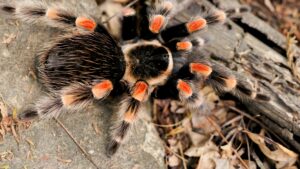
Typhochlaena costae is a Brazilian tarantula described by Rogério Bertani in 2012. This page is the taxonomic profile in our Typhochlaena group. A separate article looks closely at the evidence for its arboreal trapdoor retreats. The Brazilian jewel tarantula, Typhochlaena seladonia, is covered in its own profile.

Accepted name and range
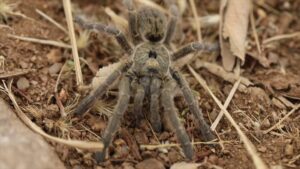
The World Spider Catalog accepts Typhochlaena costae Bertani, 2012 and lists its distribution as Brazil. The original revision records material from the states of Tocantins, Maranhão, and Piauí. Bertani noted that this species appeared to occur in drier, more open environments than most other members of the genus. World Spider Catalog; Bertani, 2012
How the species was diagnosed
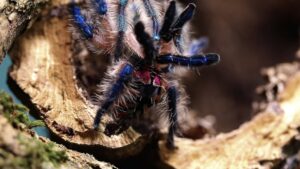
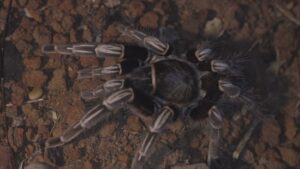
Bertani distinguished males by a short, slender embolus. Females have non-spiralled spermathecae without lobes, diverging at the base and converging toward the tips. In both sexes, the cephalothorax is brown and the upper abdomen is black with two rows of four red spots extending onto the sides. Long yellow setae occur on the carapace, upper chelicerae, and the front part of the abdomen. These characters come from the formal diagnosis, not from the color alone. Bertani, 2012, pages 25-27

What was known in 2012
The original description had no direct natural-history observations for this species. One male had been collected in a pitfall trap, one female during a faunal rescue, and one immature from fossil tree samples. This gap matters because it separates the formal description from later work on retreats and tree use. Bertani, 2012
Later natural-history records
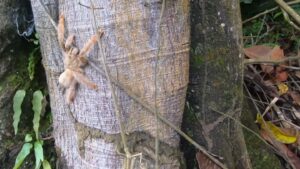
Andre and Hüsser later reported T. costae in their study of arboreal trapdoor retreats in Typhochlaena. The World Spider Catalog also links a 2020 paper devoted to tree selectivity. In central Tocantins, T. costae lives in arboreal trapdoor retreats, most at a height of 3.1 ± 1.3 m. Of all observations, 88.2% were on one tree species, Caryocar brasiliense (pequi), while Curatella americana, the tree preferred by T. seladonia, was only occasionally used (2.5% of its trees) (Andre 2020). Those studies are the relevant sources for retreat and tree-use claims. They should not be replaced by generic captive-care rules. Andre and Hüsser, 2018; WSC bibliography
Read what the literature and our photograph can actually show about the retreat. For the captive-bred portrait series and video, see our short Typhochlaena costae photo page.
Name origin
Bertani named the species for Miriam Costa, who collected the holotype and other new spider species while working at Instituto Butantan. Bertani, 2012
References
- Bertani, R. 2012. Revision, cladistic analysis and biogeography of Typhochlaena, Pachistopelma and Iridopelma. ZooKeys 230: 1-94. doi:10.3897/zookeys.230.3500
- Andre, C. and Hüsser, M. 2018. About trapdoors and bridges: new insights in the little-known ecology and lifestyle of the genus Typhochlaena. Journal of the British Tarantula Society 32(3): 3-29. author-uploaded article record
- Andre, C. 2020 (issue dated December 2019). Tree selectivity by the theraphosid spider Typhochlaena costae. Journal of the British Tarantula Society 34(3): 22-41. WSC bibliography record
- World Spider Catalog. 2026. Typhochlaena costae Bertani, 2012. Natural History Museum Bern. species record