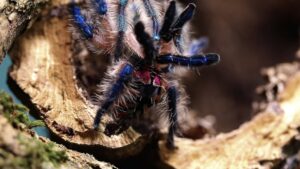
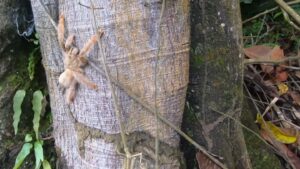
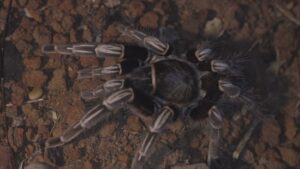
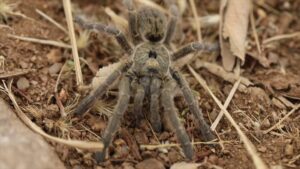
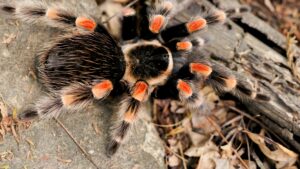
The photograph on this page shows Typhochlaena costae beside silk and bark. It does not show every step of trapdoor construction. To understand the retreat, we need to separate what is visible in one still image from what natural-history work has documented.

What the original description could not tell us
When Rogério Bertani described T. costae in 2012, he wrote that no natural-history data were available. The specimens had come from a pitfall trap, a faunal rescue, and fossil tree samples. The paper diagnosed the species and mapped its range, but it did not describe a retreat-building sequence. Bertani, 2012
The later trapdoor record
Andre and Hüsser’s 2018 paper added observations for T. costae, which appeared to share the lifestyle of T. seladonia, and described Typhochlaena as having a strictly arboreal trapdoor lifestyle. A figure caption in the paper says that retreats of T. costae typically have an entrance on each side. This supports the presence and general form of the retreat. It does not, by itself, prove claims about camouflage, prey capture, or the purpose of the spider’s colors. Andre and Hüsser, 2018 A later paper by Andre presents natural-history data on T. costae from central Tocantins, Brazil, including its arboreal trapdoor retreats and its selection of host trees. (Andre, 2020)

What this image shows
Silk is attached to the bark on both sides of the spider. The animal is outside the concealed part of the retreat. A still photograph cannot tell us the order in which the silk was laid, whether the spider was actively building at that moment, or how it used the entrance during hunting. Those questions need a recorded sequence or direct observation notes.
The bright abdominal marks also need care. Bertani described two rows of four red spots as part of the species’ color pattern, but the paper did not assign them a camouflage function. Bertani, 2012, pages 25-27
For the formal diagnosis and distribution, read our Typhochlaena costae species profile. The older Typhochlaena costae captive-bred portrait series holds the portrait series and video.
References
- Bertani, R. 2012. Revision, cladistic analysis and biogeography of Typhochlaena, Pachistopelma and Iridopelma. ZooKeys 230: 1-94. doi:10.3897/zookeys.230.3500
- Andre, C. and Hüsser, M. 2018. About trapdoors and bridges: new insights in the little-known ecology and lifestyle of the genus Typhochlaena. Journal of the British Tarantula Society 32(3): 3-29. author-uploaded article record
- Andre, C. 2020. Tree selectivity by the theraphosid spider Typhochlaena costae Bertani, 2012 (Araneae, Mygalomorphae, Theraphosidae). Journal of the British Tarantula Society 34(3): 22-41.
- World Spider Catalog. 2026. Typhochlaena costae Bertani, 2012. Natural History Museum Bern. species and bibliography record