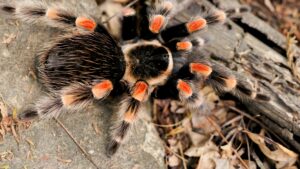
Typhochlaena is a genus of small, brightly coloured tarantulas that live only in Brazil. The World Spider Catalog accepts six species, from the Atlantic Forest of the north-east to the Cerrado of the interior.1 The best-known species, T. seladonia, is sold as the Brazilian jewel tarantula. What sets the genus apart is where it lives: at least T. seladonia builds a hinged trapdoor retreat on tree trunks, a habit that Christian Andre and I reported together in 2016 and 2018.5,3 Andre later found T. costae living the same way.6 This page covers the genus. Each species with its own page links down to it. For trapdoor spiders in general, and how they differ from trapdoor tarantulas, see Trapdoor Spiders and Trapdoor Tarantulas.
The six species and the Brazilian states they come from
The World Spider Catalog gives only “Brazil” for each species, so the states below come from the descriptions themselves. I give state level only.
| Species | Described | Brazilian states | Source |
|---|---|---|---|
| T. seladonia (C. L. Koch, 1841) | 1841 as Mygale seladonia | Sergipe and north-eastern Bahia | Bertani 2012, p. 202 |
| T. curumim Bertani, 2012 | 2012 | Paraíba; the 2025 paper also lists male material from Rio Grande do Norte | Bertani 2012, p. 21; Bertani et al. 20252,4 |
| T. paschoali Bertani, 2012 | 2012 | Southern Bahia | Bertani 2012, p. 232 |
| T. amma Bertani, 2012 | 2012 | Espírito Santo (mountain range) | Bertani 2012, p. 242 |
| T. costae Bertani, 2012 | 2012 | Tocantins, Maranhão and Piauí | Bertani 2012, p. 262 |
| T. chapadensis Bertani, Antunes & Gallão, 2025 | 2025 | Bahia (Chapada Diamantina region) | Bertani et al. 2025, p. 1044 |
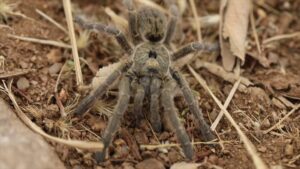
Most species are found in the Brazilian Atlantic rainforest. T. costae is the exception and seems to occur in drier, more open environments.2 The 2025 description adds a geographic note: T. curumim lives north of the São Francisco River, while T. chapadensis was found south of it.4 For the species with their own pages, see the profiles of Typhochlaena seladonia, Typhochlaena costae and the longer T. costae diagnosis and range article.
What Bertani’s 2012 revision changed
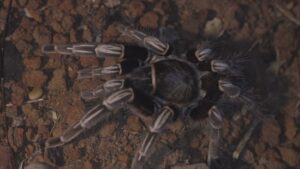
Before 2012 the genus was a muddle of old names. Koch described Mygale seladonia in 1841 and put it in the new genus Typhochlaena in 1850. Simon later folded the genus into Avicularia, and Smith moved the species to Iridopelma.3 Rogério Bertani’s 2012 monograph revised Typhochlaena, Pachistopelma and Iridopelma together, with a cladistic analysis and a biogeographic section. It restored Typhochlaena for the species and described four new ones, T. amma, T. costae, T. curumim and T. paschoali.2 The 2012 key separates the species by male palp and female spermathecae, and by colour: the metallic green carapace and legs of T. seladonia, for example, against the long curled yellow setae of T. costae.2
Bertani also noted that colour pattern does not change with age in this genus, which is unusual among the arboreal aviculariine tarantulas.2 A 2025 paper, working with the wider phylogeny, puts Typhochlaena as the sister group of the remaining aviculariines.4
The arboreal trapdoor: our 2018 paper
When I started working on this genus with Christian Andre, almost everything known about how Typhochlaena lives came from T. seladonia, and it was thin. Earlier authors had found it under loose tree bark in silk-coated retreats, and one captive animal had built a bark-and-silk retreat with one side free so that it could open it from the inside.3 Christian did the fieldwork. He spent twelve weeks searching for T. seladonia across five field periods, and the animals he found per trip came to 1, 2, 1, 8 and around 40 as he learned to recognise the right microhabitat.3 I contributed to the paper as co-author and made the distribution map and the line drawing of the spinneret.
What he found was, in our words, proof of a new type of habitat for theraphosid spiders: a strictly arboreal trapdoor lifestyle.3 The retreat is flattened and attached directly to the trunk or in a shallow depression of the bark. It is either a simple trapdoor or an oval silk tube with a single door at one end. The door is a thin, soft, roughly D-shaped lid on a hinge, with a thickened silken stop. The outside is built from bark particles taken from the spot, so the retreat looks like the tree, and the inside is always silk-lined.3
Only 10 to 20 percent of the retreats found were inhabited, and those were closed. Retreats sat from 10 centimetres up to 6 or 7 metres above the ground. The animals measured 5 to 21 millimetres, and even the smallest stages already showed the behaviour. Females hardly ever leave the retreat, and the only animal seen outside was an adult male walking at night. A retreat is not enlarged over time. A spider that outgrows it abandons it and builds another.3 The paper also notes that this lifestyle resembles part of the trapdoor spider family Migidae, although cladistic research does not suggest a close relationship.3 Our wider article on how tarantulas use silk, burrows and tree retreats puts this in context.
One more observation from the paper: in the places searched, T. seladonia seemed tied to a single tree species, Curatella americana, and we argued that it is less “very rare” than very specialised.3
A retreat lid I photographed in Paraíba
My own fieldwork on the genus was small. In 2010 I travelled to Brazil, and a local colleague showed me a sub-adult male T. curumim, a few millimetres long, that he had found in a mango tree in a small village in the state of Paraíba. I photographed the animal and the lid of its retreat on both sides. The collector said one side of the shelter had been open, and the construction looks like a trapdoor of some kind. I could not document how such a retreat looks in place, so it stays a lead and not a finding.3
Films of Typhochlaena
All of our own Typhochlaena films show T. seladonia in captivity, except one field film by Christian Andre. The links open at the point named.
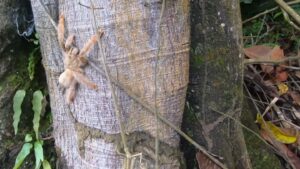
- Typhochlaena Seladonia in its Natural Habitat! is raw field footage that Christian Andre filmed for the 2018 article, with his credit on screen. At 2:00 a spider sits on a trunk next to its retreat, and at 5:00 a finger lifts the bark-coloured lid with the spider beneath it.
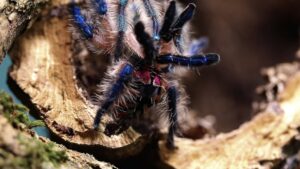
- Most colourful Pet Tarantula – Typhochlaena seladonia (captive, a glass enclosure with cork bark and lichen). At 1:22 the trapdoor is opened gently and the female is inside. At 2:14 the film explains how she scratched the lichen away and silked it back into a lid. At 3:01 I say that nobody knows why the colours are so bright, and mention the hypothesis that they resemble a flower of the host tree.
- Quarantine Tarantula Feeding – 4K T. SELADONIA Information (captive). At 0:48 the female closes the lid with her hind legs, and at 7:55 the finished retreat blends into the bark. The feeding is covered in our article on what tarantulas eat.
- Brazilian Jewel Tarantula – Most Colourful Tarantula on Earth (captive pairing). At 2:38 I say that in the wild the animals are hard to spot because of the trapdoors they build, and at 6:19 the female is camouflaged again after mating. The pairing is covered in how tarantulas mate and breed.
- Typhochlaena seladonia – SPECIAL EDITION (captive). I travelled to a breeder in Germany (0:24) to film pairings of two adult males with two freshly moulted females (0:45).
The photo at the top is a still from Most colourful Pet Tarantula (2019), a captive animal and not a wild one.
Habitat loss and the pet trade
Andre and I wrote that the Atlantic Forest has lost most of its original area. Only about 50,000 km², under 5 percent, remains of more than a million.3 The 2025 paper adds that the genus is popular in the pet market, that its species are targets of poachers, and that two of the five species known then were listed in the Red Book of Threatened Brazilian Fauna.4 All of the animals in our films were captive.
References
- World Spider Catalog (2026). Typhochlaena C. L. Koch, 1850. Natural History Museum Bern. wsc.nmbe.ch, checked 1 October 2026.
- Bertani, R. (2012). Revision, cladistic analysis and biogeography of Typhochlaena C. L. Koch, 1850, Pachistopelma Pocock, 1901 and Iridopelma Pocock, 1901. ZooKeys 230: 1-94 (pp. 15, 17, 20-26). doi:10.3897/zookeys.230.3500
- Andre, C. & Hüsser, M. (2018). About trapdoors and bridges: new insights in the little-known ecology and lifestyle of the genus Typhochlaena C. L. Koch, 1850. Journal of the British Tarantula Society 32(3): 3-29 (pp. 3-13).
- Bertani, R., Antunes, V. S. & Gallão, J. E. (2025). A new species of tiny arboreal tarantula of the genus Typhochlaena C. L. Koch, 1850 (Araneae, Theraphosidae) from the State of Bahia, Brazil. Zootaxa 5660(1): 102-110. doi:10.11646/zootaxa.5660.1.6
- Andre, C. & Hüsser, M. (2016). Die Gattung Typhochlaena: Historie und Systematik sowie Habitat und Lebensweise von T. seladonia, T. costae und T. curumim. Arachne 21(3): 4–33.
- Andre, C. (2020). Tree selectivity by the theraphosid spider Typhochlaena costae Bertani, 2012 (Araneae, Mygalomorphae, Theraphosidae). Journal of the British Tarantula Society 34(3): 22–41 (issue dated December 2019).
Explore this site
For other arboreal tarantulas, see the Aviculariinae gallery, the Theraphosidae overview and the Tarantula Gallery. The other Brazilian tarantulas and their trade names are in Brazilian tarantulas and their trade names.