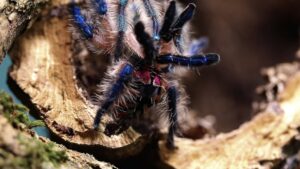
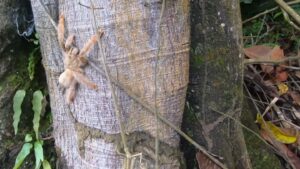
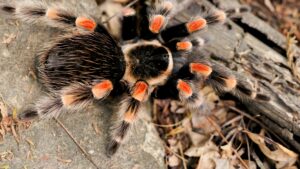
Typhochlaena seladonia is a small, brightly coloured tarantula from the Atlantic Forest of north-eastern Brazil[2][4], sold as the Brazilian jewel tarantula. It lives in trees and shuts itself into a camouflaged bark retreat with a hinged lid, a lifestyle that Andre and I first reported in 2016 as new for tarantulas[5][3], and the adult females measured in the field reached 21 mm in body length while the males stayed between 9.5 and 12.5 mm[3]. I match the other Brazilian trade names, such as salmon pink, black and white knee, to their species in Brazilian Tarantulas: Salmon Pink, Black and Jewel Names.
Accepted name and older names
The World Spider Catalog accepts Typhochlaena seladonia (C. L. Koch, 1841) and lists it as the type species of Typhochlaena[1]. Carl Ludwig Koch described it in 1841 as Mygale seladonia from a single female[4] and placed it in the new genus Typhochlaena in 1850, after which Simon merged that genus into Avicularia in 1892 and Smith moved the species to Iridopelma in 1993[1][2].
Almeida-Silva and colleagues redescribed the spider in 2008 as Iridopelma seladonium[4], and Bertani restored the original genus in 2012, so the current name is Typhochlaena seladonia[2]. The male that Mello-Leitão described under this name in 1923 belonged to a different species, as the 2008 redescription showed[1][4].
How to tell it from Typhochlaena costae
Both species have red-marked abdomens, so the abdomen alone is not enough, and Bertani describes T. seladonia of both sexes with a metallic green carapace and a black abdomen carrying two rows of six spots, the front pair reddish and the rest yellowish[2]. Typhochlaena costae has a brown carapace, two rows of four red spots, and long, stiff yellow hairs on the carapace, the top of the jaws and the front of the abdomen[2]. Under the microscope, male T. seladonia have a very long, slender embolus, the part of the palp that transfers sperm, while T. costae males have a short one[2].
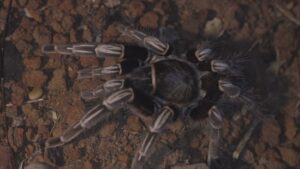
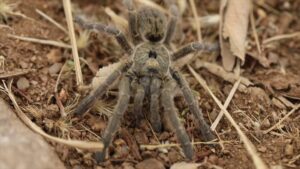
Range separates them too. T. costae is recorded from Tocantins, Maranhão and Piauí, in the Cerrado of the interior, not the coastal forest where T. seladonia lives[2]. Our Typhochlaena costae profile covers that species, and the captive-bred portrait page shows it.
Adult female T. seladonia have pink upper leg segments (femora), and males do not[4]. The rest of the legs are metallic blue to green, and unlike most Aviculariinae the young do not change their colour pattern as they grow[2][3][4].

How big does Typhochlaena seladonia get?
Andre and I report body lengths from 5 mm in small juveniles up to 21 mm in fully grown females, leaving out the jaws and spinnerets[3]. The adult females in our paper measured 14, 15, 17 and 21 mm[3]. Adult males were smaller, at 9.5 to 12.5 mm[3].
Museum specimens give similar figures: one female measured 16.7 mm in total length and one male 12.4 mm, seven females ranged from 8.0 to 18.0 mm[4], and Bertani recorded a carapace 5.4 mm long on a female and 4.6 mm on a male[2]. None of these is a leg span.
Where does it live?
Bertani gives the distribution as Sergipe and north-eastern Bahia, and Almeida-Silva and colleagues as Sergipe and Bahia[2][4]. Further south, T. paschoali in southern Bahia and T. amma in Espírito Santo take its place[3]. Andre and I place every known record below 100 m elevation, in lowland rainforest or in restinga, a coastal scrub on sandy, nutrient-poor soil[3].
The forests in that study were secondary growth, and less than 5 percent of the original Atlantic Forest remains[3][4], and the males in the 2008 study were found walking inside houses near disturbed forest remnants[4].
A trapdoor in the trees
The first hint came from a captive juvenile. It built a cup-shaped retreat from small pieces of bark fixed with silk, with one side left free so the spider could lift it from inside, a behaviour not seen before in this subfamily[4].
Field work showed that this is normal for the species. Over five field periods totalling twelve weeks, Andre found 1, 2, 1, 8 and about 40 spiders, and the count rose as he learned to recognise the right microhabitat[3]. The retreats are flat, silk-lined pockets set into shallow hollows of trunks and bark, closed by a soft, D-shaped lid on a hinge[3]. Bark from the spot is stuck to the outside, sometimes with moss or lichen on top, so the retreat is hard to see[3]. Most are only as large as the spider inside. Only 10 to 20 percent of those found were occupied[3].
Retreats sat from 10 cm to 6 or 7 m above the ground. Even the smallest juveniles appear to build them[3]. Females hardly ever leave their retreats. Adult males walk about after their final moult looking for mates and turn up mostly from September to December[3]. When a lid was opened, the spiders first tried to pull it shut again[3]. The distribution seems to be linked to one tree, Curatella americana, with the spiders probably limited to small stands of it. The authors call the species specialised rather than “very rare”[3].
What captive animals have shown
The 2008 study kept a female and a juvenile from Bahia[4]. The juvenile took only prey that touched its retreat[4]. It died after a failed moult[4]. A male and the female mated in the lab, and the male drummed his legs and palps over her body before inserting a palp[4]. The female died in a failed moult before she laid eggs[4]. Brunner and Brunner published husbandry and breeding notes in the Journal of the British Tarantula Society in 2020[6].
Caresheet and video
An interesting read is this species specific caresheet, which you could have a read on with a translator service, such as Google Translate or Microsoft Bing – you will get the most important parts for sure!
https://vogelspinnenforum.ch/lexicon/index.php?entry/293-typhochlaena-seladonia/
For a video summary of Typhochlaena seladonia, consider watching the videos mentioned below and on our playlist channel on YouTube.
References
- World Spider Catalog (2026), Typhochlaena seladonia (C L Koch, 1841), Natural History Museum Bern, accessed 30 September 2026.
- Bertani R (2012), Revision, cladistic analysis and biogeography of Typhochlaena C L Koch, 1850, Pachistopelma Pocock, 1901 and Iridopelma Pocock, 1901 (Araneae, Theraphosidae, Aviculariinae), ZooKeys 230: 1-94, doi:10.3897/zookeys.230.3500.
- Andre C and Hüsser M (2018), About trapdoors and bridges – new insights in the little-known ecology and lifestyle of the genus Typhochlaena C L Koch, 1850, Journal of the British Tarantula Society 32(3): 3-29.
- Almeida-Silva L M, Camacho A, Brescovit A D, Lucas S M and Brazil T K (2008), Redescription and notes on the natural history of the arboreal tarantula Iridopelma seladonium (Araneae: Theraphosidae: Aviculariinae), Revista Brasileira de Zoologia 25(4): 728-736.
- Andre C and Hüsser M (2016), Die Gattung Typhochlaena – Historie und Systematik sowie Habitat und Lebensweise von T. seladonia, T. costae und T. curumim, Arachne 21(3): 4-33.
- Brunner A and Brunner P (2020), Information On The Husbandry & Breeding of Typhochlaena seladonia (C L Koch, 1841), Journal of the British Tarantula Society 35(1), April 2020.