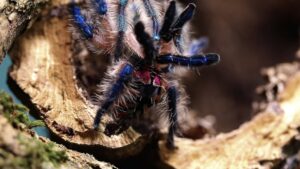
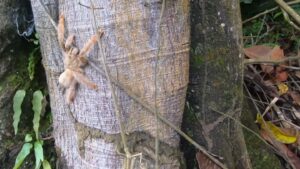
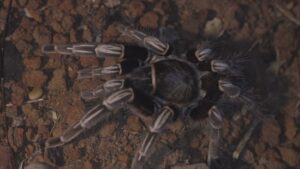
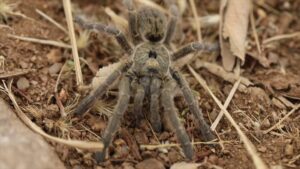
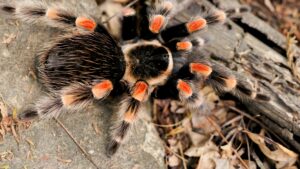
Urticating hairs are microscopic, barbed hairs that many New World tarantulas flick off their abdomen, or in one genus off their pedipalps, or press into an attacker. They can irritate skin and eyes and, if inhaled, the airways,[3] and they are the reason a bothered New World tarantula can end up with a bald patch.[5] Seven structural types are known, called I to VII, and no tarantula from the Old World has any of them.[1][4]
What are urticating hairs?
The scientific term is urticating setae. They are modified body hairs with a penetrating tip and barbs that help them stay in whatever they hit, and they break off the spider at a weak point near the base.[2] In the large 2019 revision by Kaderka and colleagues, which looked at 144 New World tarantula taxa, they are described as a defence against vertebrate and invertebrate predators and intruders. They also help taxonomists, because the type of hair is a character that separates groups of New World tarantulas.[1] Not every hair on a tarantula is a weapon: other setae are sensory and pick up vibration and moving air.
They are not rare in the Americas. In 2013 Bertani and Guadanucci counted urticating setae in roughly 540 of the 600 described New World species and put it at about 90 percent.[2] Where they come in contact with a mammal they penetrate skin or mucous membranes and cause physical irritation.[1] What that means for a person, and what to do about it, is on our page Are tarantulas poisonous?, so we do not repeat it here.
What are the seven types of urticating hairs?
Cooke and colleagues described types I to IV in 1972. Marshall and Uetz added type V, Pérez-Miles type VI and Perafán and colleagues type VII.[1] In short:
- Type I. Barbs point back toward the base of the hair. The hair sits on the upper side of the abdomen of many Theraphosinae, such as Aphonopelma, Brachypelma and Nhandu.[1]
- Type II. A stout, nearly straight hair with a penetrating tip at both ends and short, scale-like barbs near the base. It belongs to the Aviculariinae, the pinktoes and their relatives.[1]
- Type III. A long, thin hair with barbs along much of its length, from 0.07 up to 1.25 millimetres in the species measured. It is found in many Theraphosinae, often together with type I or IV.[1]
- Type IV. A small hair, up to 0.20 millimetres, with a bent shaft and strong barbs at the base. It occurs only in South American Theraphosinae.[1]
- Type V. Barbs point forward along a nearly straight hair of 0.55 to 0.67 millimetres. These hairs sit in sockets on the palps of Ephebopus and nowhere else on the body.[1]
- Type VI. Known from the Mexican genus Hemirrhagus, apart from some cave-dwelling species. It looks like type II but has long barbs in the outer half.[1]
- Type VII. Found so far only in the Colombian genus Kankuamo.[1]
One caution: the typology is not frozen. The 2019 revision redescribed types I, III and IV, and hairs that earlier authors had placed in type III, or called intermediate between I and III, are now treated as ontogenetic subtypes of type I.[1] Older papers and care sheets may use the earlier scheme.
Which tarantulas have which type?
| Group | Type | Where on the spider | How it is released |
|---|---|---|---|
| Theraphosinae (most genera) | I, III, IV, alone or combined, for example I+III in Brachypelma and Nhandu, III+IV in Grammostola, III in Theraphosa | Upper abdomen | Flicked with the hind legs[1][2] |
| Theraphosinae: Hemirrhagus, Kankuamo | VI, VII | Abdomen | Kankuamo probably by contact, which has not been observed directly[1][3] |
| Aviculariinae (Avicularia, Caribena, Antillena, Iridopelma, Pachistopelma, Typhochlaena, Ybyrapora) | II | Abdomen | Mostly by contact, airborne in Caribena versicolor[1] |
| Psalmopoeinae: Ephebopus only | V | Palps | Palps scraped along the chelicerae[1] |
| Psalmopoeinae: Psalmopoeus, Tapinauchenius, Pseudoclamoris; Schismatothelinae; Ischnocolinae | None |
The genus-level types follow Table 1 of the 2019 revision, which collects published records.[1] That the Psalmopoeinae and Schismatothelinae lack the hairs, and that Ephebopus is the single exception inside the Psalmopoeinae, is also what the 2019 phylogenomic study found.[3] It is the same pattern we described on our page about Psalmopoeus cambridgei, which has none.[6] The pinktoes of the Aviculariinae are covered under Caribena versicolor, and Nhandu chromatus is one of the type I and III species.
How do tarantulas release them?
There are three methods, and which one a tarantula uses depends on the group.[1][2]
- Flicking. Most Theraphosinae scratch their fourth pair of legs across the hair patch on the abdomen and throw a cloud of hairs toward the threat. Researchers also call it bombardment.[2][3]
- Contact. In Avicularia, Iridopelma and Pachistopelma the hairs mostly come off when the abdomen touches the intruder.[1][2]
- Palps. Ephebopus moves its palps along the base of the chelicerae, which sends the hairs toward the intruder.[1]
Some Theraphosinae also work the hairs into the silk of a moulting mat or an egg sac. In the 2013 experiments by Bertani and Guadanucci, only two of 15 ants crossed a tube lined with the moulting web of a Lasiodora female, which carried urticating hairs, and a fly larva placed on such a web was found dead, pierced by many type I hairs.[2] That passive use is part of the same story as the silk on our page on tarantula webs, and the egg sac itself comes up in how tarantulas mate and breed.
What flicking looks like in the field

This is the clip where we show it most clearly. We found an Agnostopelma high in the Colombian Andes, a genus that Table 1 of the revision lists with types III and IV.[1] In the film we say the spider flicks its hairs at a slow speed (from 4:10), that the footage is not slow motion, and that she turns her abdomen to one side to throw hairs at us before walking away (5:23 to 5:45).
Field footage from the Colombian Andes, 2021. The flicking sequence runs from 5:06 to 5:45.
The palps of Ephebopus
In our film about the 2019 phylogenomic paper (reference 3), we say that Ephebopus has its hairs on the pedipalps, not on the abdomen, so an adult sitting at the entrance of its burrow can flick them at an intruder while looking straight at it (3:13 to 3:47). The film also shows a juvenile in a planted enclosure that builds a silk retreat like an Avicularia. The paper carries a photograph credited to me, and in the film (1:28 to 2:03) I describe it: a small Theraphosinae from the Ecuadorian highlands that was flicking hairs at me, with the loosened hairs still hanging together because it had not finished the move.
In the film we go through the palpal hairs of Ephebopus and the 2019 paper, with footage of a captive juvenile.
We showed the same photograph again in our livestream about the Ecuador trip, where it starts at 21:01. I call it probably the best picture I have taken of a tarantula, and you cannot stage something like it.
What do urticating hairs do to animals?
Bertani and Guadanucci think the hairs serve different targets. Type I hairs, which small invertebrates meet in moulting webs and egg sacs, seem aimed at ants and fly larvae, while the long type III hairs are the ones thrown at large vertebrates.[2] They also propose that the longer a hair is, the stronger the reaction, and the longest hairs sit in the middle and rear of the abdomen, which is the area the spider usually flicks first.[2] That fits what is said of the genera with long type III hairs, such as Lasiodora, Grammostola, Acanthoscurria and Brachypelma smithi, which the literature calls particularly irritating.[2] The same paper notes that older work reported severe effects on the airways of rats and mice that breathed Grammostola hairs.[2] In our film on Nhandu chromatus (at 6:12 to 7:02) we warn that it has one of the worst urticating hairs for mammals, so a keeper who reacts strongly to hairs should think twice.
Ron Baxter describes the other side. Hairs fine enough that thousands drift away at once, discomfort that is certain if they reach the eyes or nose, and a raccoon that rolls a tarantula between its paws and in dry earth until it has no hairs left and can be eaten.[5]
Why does a tarantula get a bald patch?
Every flick takes hairs off. In our film on giant tarantulas we say that Xenesthis use the hairs very often, especially when young, which makes bald abdomens come quickly (from 1:56). Baxter turns this around for the Old World: those tarantulas have no hairs to shed and so never show a bald patch.[5] Not every hair on a tarantula is defensive, though: some make its colour, as in why are tarantulas blue.
Do Old World tarantulas have urticating hairs?
No. Urticating setae have been found only in New World tarantulas and are absent in the Old World subfamilies.[4] The 2019 phylogenomic study, which used transcriptome data from 25 genera, put four New World subfamilies together in what the authors call the bombardier clade, and every species in their tree that has urticating setae and has been seen bombarding belongs to it.[3] How the hairs arose is still open. The authors sketch three scenarios, and the one their data favour has the hairs evolving separately in the Theraphosinae, in the Aviculariinae and in Ephebopus.[3] They also point out that every species with reliably reported medically significant bites and potent venom lacks the hairs, and they suggest, as a thought experiment, that cheap urticating hairs could have let New World tarantulas lose costly venom components.[3] It is a hypothesis, not a result. For the family as a whole, see our Theraphosidae overview. The wider comparison is on Old World vs New World Tarantulas.
Short answers
Do tarantulas shoot their hairs?
Many flick them with the hind legs and throw a cloud, so they are thrown rather than shot. Others, such as most pinktoes, mainly release them by touch.[1][2]
Which tarantulas have no urticating hairs?
All Old World tarantulas, and in the New World the Schismatothelinae, the Ischnocolinae and most Psalmopoeinae, such as Psalmopoeus.[2][3][4]
Is the bald patch dangerous for the tarantula?
We found no source that says so. A bald patch shows where hairs have been used, and the sources we read do not discuss any further risk to the spider.
References
- Kaderka, R., Bulantová, J., Heneberg, P. & Řezáč, M. (2019). Urticating setae of tarantulas (Araneae: Theraphosidae): morphology, revision of typology and terminology and implications for taxonomy. PLOS ONE 14(11): e0224384. doi:10.1371/journal.pone.0224384. Open access; pages 1–5 and 14–18 used here.
- Bertani, R. & Guadanucci, J. P. L. (2013). Morphology, evolution and usage of urticating setae by tarantulas (Araneae: Theraphosidae). Zoologia 30(4): 403–418. doi:10.1590/S1984-46702013000400006. Open access.
- Foley, S., Lüddecke, T., Cheng, D.-Q., Krehenwinkel, H., Künzel, S., Longhorn, S. J., Wendt, I., von Wirth, V., Tänzler, R., Vences, M. & Piel, W. H. (2019). Tarantula phylogenomics: a robust phylogeny of deep theraphosid clades inferred from transcriptome data sheds light on the prickly issue of urticating setae evolution. Molecular Phylogenetics and Evolution 140: 106573. doi:10.1016/j.ympev.2019.106573.
- Perafán, C. & Pérez-Miles, F. (2010). Euathlus latithorax (Strand, 1908) is a synonym of E. vulpinus (Karsch, 1880). Bulletin of the British Arachnological Society 15(2): 49–51, p. 49 (introduction), which states that urticating setae are found exclusively in New World Theraphosidae and absent in Old World subfamilies.
- Baxter, R. N. (1993; rev. ed. A. Smith, 2014). Baxter’s Bumper Book of Tarantulas. Fitzgerald Publishing, p. 19.
- World Spider Catalog (2026). Natural History Museum Bern, checked 1 October 2026 for the genus names used here.
- birdspidersCH, This is the Slowest Tarantula on Earth! (2021); Ephebopus and Urticating Hairs! Evolution and husbandry notes (2019); Live Tarantula Fieldtrip Stories! Ecuador and Pamphobeteus ultramarinus (2019); Biggest spiders caught on film – Xenesthis Edition; 4K Brazilian Giant Tarantula | Nhandu chromatus & Nhandu tripepii.