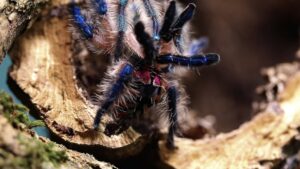
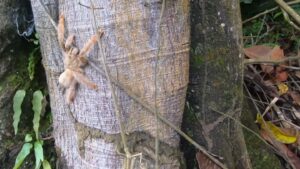
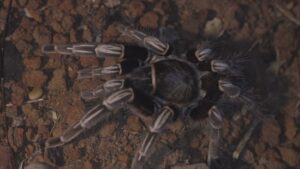
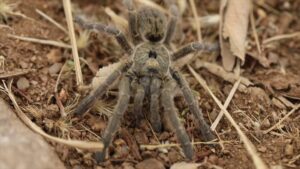
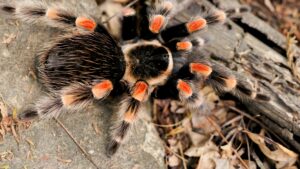
In the wild, tarantulas eat mostly arthropods that come close to the burrow or retreat: beetles, ants and termites, crickets, grasshoppers, caterpillars, wasps, other spiders and small scorpions. Large species sometimes take small vertebrates, including lizards, snakes, birds and bats, but the published records are single observations of single species and do not describe the whole family. The tarantulas in our feeding videos further down are captive animals eating crickets, cockroaches and superworms.
What do tarantulas eat in the wild?
Diet records for tarantulas sit in the natural-history notes of species descriptions and revisions, one species and one place at a time. The family has about 1,200 species[11] on every continent except Antarctica,[10] so no single list covers it. What follows is what those papers state, taxon by taxon.
Beetles, ants, crickets and other arthropods
- Aphonopelma of the Mojave Desert, USA. Prentice found remains of beetles (mostly tenebrionids), small to medium scorpions, spiders of other families and orthopterans in burrow chambers of A. iodium, and beetles made up most of what could be identified. The prey of A. joshua and A. mojave included beetles, harvester ants, small orthopterans and, occasionally, small scorpions.[1]
- Homoeomma chilense, Chile. The describers say only that spiders have been observed feeding on ground beetles, wasps and other spiders, without giving details.[2] Its names, range and the film we made in the field are on our page about the Homoeomma chilense flame tarantula.
- Grammostola rosea, Chile. A Chilean population study says the species consumes crickets of the family Gryllidae and beetles, mainly scarabs. The paper does not separate field observations from animals kept in the laboratory.[3]
- Phlogiellus khampheng, Laos. This dwarf tarantula is often found near colonies of ants and termites. Remains of both turn up in its retreats, which the authors take to mean that ants and termites are a significant part of the diet.[4]
- Orphnaecus pellitus, the Philippines. It lives on cave floors and was observed feeding on cave crickets (Rhaphidophoridae), which are abundant there. The authors think it probably takes other arthropods too but have no observations of it.[5]
Lizards, snakes and other vertebrates
- Tapinauchenius montufari, Ecuador. An arboreal species whose females, the authors write, may capture prey much larger than themselves. Adult females have been seen preying on katydids and on the introduced South Asian house gecko, Hemidactylus frenatus. Juveniles take large cicadas, grasshoppers and caterpillars.[6]
- Pamphobeteus jamacoaque, Ecuador. It digs burrows near streams and small rivers and mainly eats insects. One adult male was seen in the wild preying on a juvenile snake, Mastigodryas pulchriceps, an observation the authors received as a personal communication.[7]
- Lasiodora klugi, Brazil. On the largest island of the Abrolhos Archipelago, Brazil, it is abundant and can feed on lizards of the genus Tropidurus.[9]
Vertebrate records need care. Bertani’s 2023 revision of Lasiodora goes back to published reports of a tarantula eating a lizard, a bat and a treefrog. In two cases the photographs or localities point to a different spider: the lizard eater was L. parahybana and not L. klugi, and the treefrog eater has the scopulae of an arboreal tarantula and is probably an Iridopelma. For the bat record, Bertani notes that no image or locality was given to confirm the species.[9]
Do tarantulas eat birds?
Some arboreal species do, now and then. The German word Vogelspinne, bird spider, probably comes from Maria Sibylla Merian’s 1705 engraving of a tarantula feeding on a bird.[8] Naturalists of the time ridiculed the idea of a bird-eating spider. Fukushima and Bertani write that we now know Merian drew a real predation event.[8]
Bates saw a similar scene in 1863 in Brazil, with Avicularia avicularia feeding on a small bird inside its webbed retreat in a tree.[8] The same revision lists a predation on a bird, Troglodytes musculus, by Avicularia variegata in an urban park in Manaus, and a report of an adult female Avicularia juruensis feeding on a greater sac-winged bat in Peru.[8] Each is one record for one species. For the largest tarantula of all, see what Goliath birdeaters eat.
How does a tarantula catch its prey?
Tarantulas are usually sit-and-wait predators with nocturnal habits. Adult females stay in the retreat most of the time and leave it only to capture prey and to discard remains.[10]

Prentice describes the sequence in Mojave Aphonopelma. The spider detects prey through vibrations in the ground and turns toward the source. If the prey is near and the vibrations are strong enough, it rushes, scoops the prey toward its opening fangs with the front legs and impales it almost at once. It then lifts the struggling victim clear of the ground, and most spiders go straight back into the burrow to eat inside.[1] Venom serves prey capture and digestion first, and defence against predators second.[10]
Feeding videos from our collection
The films below show captive tarantulas from our collection eating feeder insects. They show what we fed and how the animals reacted on camera, and nothing in them describes a wild diet. Another feeding film, our bioactive feeding tour, sits with its species on the Monocentropus balfouri page.

When tarantulas attack while feeding them
Captive footage from our collection, 2021. Old World tarantulas are defensive, so tickling them out of the burrow with a wooden stick and feeding them cockroaches is not the gentlest approach. It is the same stick we use in the field to film wild tarantulas. The film starts with Old World species at 1:20, moves to arboreal Psalmopoeus at 6:20, to a terrestrial New World tarantula of uncertain genus at 8:33, and ends with baboon tarantulas at 11:20.
Bioactive tarantula feeding frenzy
Captive footage from our collection, 2021, made while we could not travel. New World tarantulas in our bioactive enclosure take crickets and other insects, with brief comments on their husbandry. The chapters run through Avicularia at 0:35, Chromatopelma cyaneopubescens at 3:47, a Chilean tarantula at 5:12, Lasiodora klugi at 7:27, a Pamphobeteus at 10:10 and Brachypelma hamorii at 15:46.
Terrestrial tarantulas feeding on superworms
Captive footage from our collection, 2022. In the film we offer superworms to several terrestrial tarantulas, mostly New World species with a few colourful Old World ones. The catch is that several refuse to eat, and the film blames our talking: voices make vibrations that tarantulas are very sensitive to.
Quarantine feeding with an adult female Typhochlaena seladonia
Captive footage in 4K, March 2020. In the film we feed an adult female Typhochlaena seladonia, and later other tarantulas including Pamphobeteus and Theraphosa species. We do not usually put feeding clips on the channel, and this one is an exception. There is more on the species on our Typhochlaena seladonia page.
Feeding day with crickets and roaches
Captive footage from our collection, a short edit from August 2021. Hungry tarantulas take crickets and roaches, shot in a deliberately futuristic style; the video description says plainly that some of it is fiction.
More on tarantula natural history
Where these animals live, from burrows to treetops, is on our page about where tarantulas live. The bite and the hairs are covered in are tarantulas poisonous, and our series on Chilean tarantulas in the wild has the field films from Chile.
References
- Prentice, T. R. (1997). Theraphosidae of the Mojave Desert west and north of the Colorado River (Araneae, Mygalomorphae, Theraphosidae). Journal of Arachnology 25: 137–176.
- Montenegro V., R., Aguilera, M. A. & Casanueva, M. E. (2018). First record of Homoeomma Ausserer, 1871 in Chile and description of two new species (Araneae, Theraphosidae). Spixiana 41(1): 13–25.
- Aguilera, M. A., Montenegro V., R. & Casanueva, M. E. (2019). Impact of disturbed areas on Theraphosidae spiders diversity (Araneae) and first population data of Grammostola rosea (Walckenaer) in Panul Park. Ecology and Evolution 9: 5802–5809. doi:10.1002/ece3.5163
- Sriranan, P., Songsangchote, C., Sihavong, O., Sayavongsa, P., Sidavong, K., Satakoun, L., Inkhavilay, K., Chomphuphuang, N. & Gabriel, R. (2025). A new species of Southeast Asian dwarf tarantula in the genus Phlogiellus Pocock, 1897, from Lao PDR (Theraphosidae, Selenocosmiinae). ZooKeys 1247: 19–43. doi:10.3897/zookeys.1247.155398
- Acuña, D. C., Ragasa, L. R. P., Santiago-Bautista, M. R., von Wirth, V. & Guevarra, L. A. Jr. (2025). Revisiting and rediscovering the tarantulas (Araneae, Theraphosidae) of Culapnitan (Libmanan) Caves in the Philippines: troglomorphism, taxonomy, phylogeny and ecological niche. Subterranean Biology 52: 143–186. doi:10.3897/subtbiol.52.142334
- Peñaherrera-R., P., León-E., R. J., Guerrero-Campoverde, A., Falcón-Reibán, J. M., Fajardo-Torres, J. D., Picón-Rentería, P., Gabriel, R., Sherwood, D. & Cisneros-Heredia, D. F. (2025). Novel insights on Psalmopoeinae Samm & Schmidt, 2010 (Araneae: Theraphosidae): new species, taxonomic restorations, and reversal of four erroneous synonymies. Arachnology 20(3): 491–508.
- Sherwood, D., Gabriel, R., Peñaherrera-R., P., León-E., R. J., Cisneros-Heredia, D. F., Brescovit, A. D. & Lucas, S. M. (2023). Pamphobeteus Pocock, 1901: redescriptions, new species and records, description of a missing sex, with taxonomic notes and changes in Megaphobema Pocock, 1901 (Araneae: Theraphosidae). Arachnology 19(6): 894–930.
- Fukushima, C. S. & Bertani, R. (2017). Taxonomic revision and cladistic analysis of Avicularia Lamarck, 1818 (Araneae, Theraphosidae, Aviculariinae) with description of three new aviculariine genera. ZooKeys 659: 1–185. doi:10.3897/zookeys.659.10717
- Bertani, R. (2023). Taxonomic revision and cladistic analysis of Lasiodora C. L. Koch, 1850 (Araneae, Theraphosidae) with notes on related genera. Zootaxa 5390(1): 1–116. doi:10.11646/zootaxa.5390.1.1
- Pérez-Miles, F. (2020). Introduction to the Theraphosidae. In: Pérez-Miles, F. (ed.), New World Tarantulas, Zoological Monographs 6, Springer, chapter 1: 1–23. doi:10.1007/978-3-030-48644-0_1
- World Spider Catalog (2026). Natural History Museum Bern. wsc.nmbe.ch, used for the accepted names above and for the species count (1,209 accepted species on the Theraphosidae family page, accessed 2 October 2026).