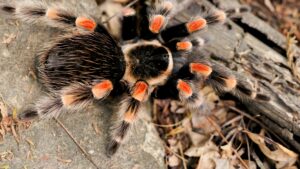
Tarantulas live on every continent except Antarctica, mostly in tropical and subtropical regions, and the Neotropics hold the largest share of species.[1] Most species shelter in burrows or crevices on the ground, and others live in silken retreats in trees.[1] Their habitats run from desert and grassland to rainforest and from sea level to more than 4,000 metres, and a few Mexican species live only in caves.[2][3]
| Question | Answer | Source |
|---|---|---|
| Which continents? | The Americas, Africa, Asia, Australia and the Mediterranean part of Europe; not Antarctica | [1][9] |
| Where are most species? | In the Neotropics | [1] |
| On the ground? | Most species shelter in burrows or crevices; most Aphonopelma live in silk-lined burrows | [1][5] |
| In trees? | Arboreal forms, mainly in the tropical New World and also in Africa and Asia | [8] |
| In caves? | A few, in the Mexican genus Hemirrhagus; one species was collected on a cave wall 400 metres from the entrance | [3] |
| How high? | Up to 4,689 metres above sea level, Antikuna valladaresi, Peru; the earlier record was 4,524 metres, Hapalotremus vilcanota | [13][12] |
Which parts of the world have tarantulas?
Tarantulas, the family Theraphosidae, occur in the Americas, Africa, Asia, Australia and the Mediterranean part of Europe. The family is absent from Antarctica.[1][9] The family is most diverse in the tropics, and most species are Neotropical.[1] A few genera and species show how wide the spread is. Country names below follow the World Spider Catalog.[4]
- North and Central America: Aphonopelma ranges across the southern third of the United States, west of the Mississippi River to California, and south through Mexico and Central America.[5] Field records from the region are collected in tarantulas of Mexico in the wild and on the page for Aphonopelma seemanni.
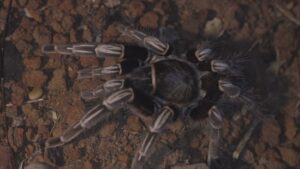
- South America: the goliath birdeater, Theraphosa blondi, is recorded from Venezuela, Guyana, Suriname, French Guiana and Brazil.[4] Two pages follow this species, an encounter in Suriname and a page on the largest spider in the world.
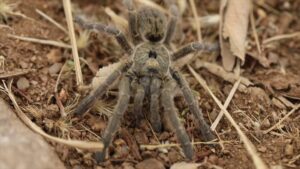
- Africa: Ceratogyrus brachycephalus is recorded from Botswana, Zimbabwe and South Africa, which puts the family well south of the equator on this continent.[4]
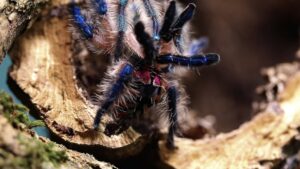
- Asia: Poecilotheria regalis is recorded from India, and the cobalt blue tarantula, Melopoeus lividus, from Myanmar and Thailand.[4] A field record of the second species is on the page about the cobalt blue tarantula in Thailand.
- Australia: Selenocosmia strenua is recorded from Queensland, so the family reaches the Australian continent as well.[4]
- Europe: Ischnocolus valentinus is recorded from Spain, and Chaetopelma lymberakisi was described from Crete in 2019.[4][6] The Spanish species has its own page, Ischnocolus valentinus, the tarantula of Spain and Morocco.
Readers who want the family as a whole can use the Theraphosidae overview, and the tarantula gallery sorts the pictures by subfamily.
Do tarantulas live in the ground?
Most do, because most tarantula species live in burrows or crevices on the ground.[1] Tarantulas are described as living more or less hidden in burrows, under stones or in silken retreats on the ground or on trees.[1] Within Aphonopelma, most species live in silk-lined subterranean burrows and occur in nearly every habitat across the genus range.[5] A study of Mexican Brachypelma and Brachypelmides found that every species studied lived in a soil burrow, sometimes near rocks or trees and sometimes in open ground not far from vegetation.[7]
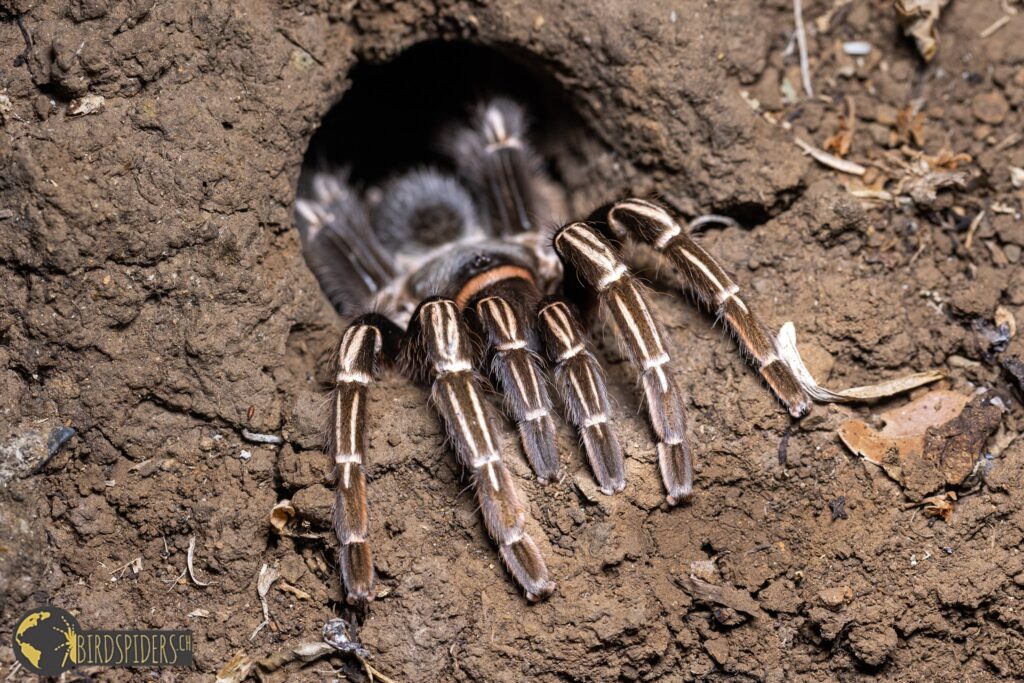
A burrow describes the retreat and not the whole animal, and the same word can cover several different habits. The fossorial tarantulas page shows what wild burrows look like on film and what a burrow can and cannot say about a species.
Do tarantulas live in trees?
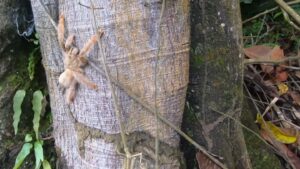
Some do, because other tarantulas are arboreal and live in silken retreats on trees.[1] Arboreal forms are found mainly in the tropical New World, and also in Africa and Asia.[8] Psalmopoeus species live in a variety of microhabitats, including trunk cavities, under bark, in palm trees and in rock cavities.[9]
The Brazilian jewel tarantulas of the genus Typhochlaena are a documented tree specialist. Christian Andre and I describe a strictly arboreal trapdoor lifestyle for the genus, a lifestyle new to the family Theraphosidae.[10] The Brazilian jewel tarantula page covers the species.
One species can use more than one kind of site. In Trinidad, Psalmopoeus cambridgei was found in a tall tree, in a metal pipe beside bamboo and in folded leaves, and one spider lived in a burrow in a roadside embankment with no tree in sight.[11] The full set of photographs is on the Trinidad chevron tarantula page.


What climates and altitudes do tarantulas live in?
Tarantulas occupy deserts, grasslands, evergreen forests, rainforests and páramo.[9] Across the family they range from sea level to more than 4,000 metres.[1] In the United States, some Aphonopelma species thrive in the hot, arid country near Death Valley, while others live in more temperate high-elevation forests in Arizona.[5]
The highest record for the family is 4,689 metres above sea level, for Antikuna valladaresi in central Peru, from a 2021 paper I co-authored.[13] It replaced the earlier record of 4,524 metres for the Andean spider Hapalotremus vilcanota.[12] Hapalotremus martinorum belongs to the genus that held that earlier record.
Do any tarantulas live in caves?
A few do. The Mexican genus Hemirrhagus includes surface-living, cave-visiting and strictly cave-dwelling species.[3] One of five cave species described in 2018 lives only inside its cave, where it was collected on the walls 400 metres from the entrance.[3]
Do tarantulas live in the United States?
Yes, because the genus Aphonopelma lives across the southern third of the United States, from west of the Mississippi River to California, and continues south through Mexico and Central America.[5] Their burrows appear in rocky ground, desert and grassland, as scrapes under rocks or as free-standing holes.[5]
Are there tarantulas in Europe?
Yes, a few small species live there. Ischnocolus valentinus is recorded from Spain, and Chaetopelma lymberakisi was described from the Greek island of Crete.[4][6] Neither resembles the large tropical species that most people picture when they hear the word tarantula.
One habitat does not describe every tarantula
A habitat is a fact about a species and a place, not about the family. A burrow in Central America, a tree retreat in Trinidad and a cave wall in Mexico are three different records, and each one holds only for the animal and site shown. Whether a tarantula counts as a spider in the first place is a separate question, and I answer it in Are Tarantulas Spiders?
Sources
- Pérez-Miles F (2020) Introduction to the Theraphosidae. In: Pérez-Miles F (ed) New World Tarantulas. Zoological Monographs 6. Springer, pp 1–23 (abstract; pp 2, 10, 17). doi:10.1007/978-3-030-48644-0_1
- Ferretti N, Cavallo P, Chaparro JC, Ríos-Tamayo D, Seimon TA, West R (2018) The Neotropical genus Hapalotremus Simon, 1903, with the description of seven new species and the highest altitude record for the family. Journal of Natural History 52: 1927–1984. doi:10.1080/00222933.2018.1506521
- Mendoza JI, Francke OF (2018) Five new cave-dwelling species of Hemirrhagus Simon 1903 (Araneae, Theraphosidae, Theraphosinae). Zootaxa 4407(4): 451–482 (pp 451, 460). doi:10.11646/zootaxa.4407.4.1
- World Spider Catalog. Natural History Museum Bern. Species pages for Theraphosa blondi, Ceratogyrus brachycephalus, Poecilotheria regalis, Melopoeus lividus, Selenocosmia strenua, Ischnocolus valentinus and Chaetopelma lymberakisi. Accessed 1 October 2026.
- Hamilton CA, Hendrixson BE, Bond JE (2016) Taxonomic revision of the tarantula genus Aphonopelma Pocock, 1901 (Araneae, Mygalomorphae, Theraphosidae) within the United States. ZooKeys 560: 1–340 (p 4). doi:10.3897/zookeys.560.6264
- Chatzaki M, Komnenov M (2019) Description of a new Chaetopelma (Araneae, Theraphosidae) species from Crete and a re-description of Macrothele cretica Kulczyński, 1903 (Araneae, Macrothelidae). Zootaxa 4544(2): 269–284. doi:10.11646/zootaxa.4544.2.7
- Locht A, Yáñez M, Vázquez I (1999) Distribution and natural history of Mexican species of Brachypelma and Brachypelmides (Theraphosidae, Theraphosinae) with morphological evidence for their synonymy. Journal of Arachnology 27: 196–200 (p 198).
- West RC, Marshall SD, Fukushima CS, Bertani R (2008) Review and cladistic analysis of the Neotropical tarantula genus Ephebopus Simon 1892 (Araneae: Theraphosidae) with notes on the Aviculariinae. Zootaxa 1849: 35–58 (p 35).
- Dupérré N, Tapia E (2024) Description of a new Psalmopoeus Pocock, 1895 species (Araneae, Theraphosidae, Psalmopoeinae) from the Chocó region of Ecuador. Zootaxa 5437(4): 495–509 (p 495). doi:10.11646/zootaxa.5437.4.3
- Andre C, Hüsser M (2018) About trapdoors and bridges: new insights in the little-known ecology and lifestyle of the genus Typhochlaena C. L. Koch, 1850. Journal of the British Tarantula Society 32(3): 3–29 (p 26).
- birdspidersCH field observations, Trinidad: Trinidad chevron tarantula in the wild.
- Ferretti N et al. (2018), as in reference 2 (p 1935).
- Kaderka R, Ferretti N, Hüsser M, Lüddecke T, West R (2021) Antikuna, a new genus with seven new species from Peru (Araneae: Theraphosidae: Theraphosinae) and the highest altitude record for the family. Journal of Natural History 55(21–22): 1335–1402 (pp 1335, 1339). doi:10.1080/00222933.2021.1936680