Tarantulas look blue because of fine, specialised hairs, not because of a blue pigment. Thin layers of cuticle and air inside those hairs reflect blue light by interference. Rainer Foelix, Bruno Erb and Benno Wullschleger showed this under the electron microscope in Aarau in 2009, and later work confirmed and extended it.[1][4] How often blue evolved, and what it is for, is still argued over: two large studies reach different answers, and the old assumption that tarantulas cannot see colour has been questioned.[4][5]

Is the blue in a tarantula a pigment?
No. Colour in animals comes from pigments that absorb some wavelengths, from nanostructures that reflect or scatter light, or from both together. Tarantula blue belongs to the second group.[4][10]
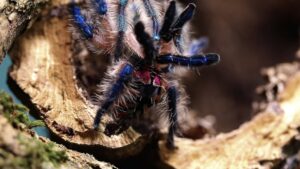
The first clue is visible under a simple stereo microscope. The blue sits only in very thin hairs, about 5 micrometres across, while the cuticle underneath is brownish black and the large sensory hairs, about 30 micrometres thick, are brown. The blue hairs lie flat between the upright sensory hairs. On the carapace of the Antilles pinktoe, for example, they form a felt of pale blue between the scattered dark hairs. Put the same blue hairs under an ordinary light microscope with light shining through them, and they look almost colourless.[1] A pigment would not disappear like that.
Hsiung and colleagues added the decisive test in 2015. When they soaked blue hairs in a liquid with the same refractive index as cuticle, the colour vanished, which is the signature of structural colour.[4] The same tarantulas still carry pigments: in their survey, every genus had at least one species in yellow, orange, red, brown or black.[4]
The 2009 discovery: layers of cuticle and air
Foelix, Erb and Wullschleger studied moults of six blue species: the Antilles pinktoe (Caribena versicolor, then Avicularia versicolor), the greenbottle blue (Chromatopelma cyaneopubescens), Ephebopus cyanognathus with its blue chelicerae, the blue-foot baboon Idiothele mira (still undescribed then, as Idiothele sp. “blue foot”), Monocentropus balfouri and Poecilotheria metallica. They used light microscopy, scanning electron microscopy and ultrathin sections for the transmission electron microscope.[1]
They found two types of blue hair. One type is finely feathered, with tiny side branches in about ten rows. The other carries several long ridges. The feathered branches sit 2 to 3 micrometres apart, far too coarse to produce interference colour, which needs structures of about 0.1 to 0.3 micrometres. So the colour had to come from inside the hair wall.[1]
The sections of the blue chelicera hairs of Ephebopus cyanognathus showed exactly that. The wall of each hair is built from several layers of cuticle, each 50 to 70 nanometres thick, alternating with air-filled gaps. Even the outer wall, which looks solid in the scanning microscope, turns out to have three layers: about 55 nanometres of cuticle, about 75 nanometres of air and about 70 nanometres of cuticle. With cuticle at a refractive index of about 1.6 and air at 1, layers of this thickness reflect light of around 400 nanometres, a deep blue, a figure the authors calculated with the vision scientist Michael Land. The thick sensory hairs and bristles have no such layers; their walls are solid and several micrometres thick.[1]
In their 2013 book chapter, Foelix, Erb and David Hill described these hairs in more detail. They are 100 to 200 micrometres long and star-shaped in cross section. Only the core of the shaft is solid cuticle, and the authors suggest it absorbs the light that is not reflected, like the dark backing of a mirror. Around it, five or six cuticle layers alternate with air gaps of 60 to 120 nanometres. A calculated reflectance spectrum for this stack peaks in the violet-blue at 430 nanometres, with a smaller peak in the green at 540 nanometres and strong reflection in the ultraviolet.[3]
The paper also reported two observations that matter for anyone who keeps blue tarantulas:
- The angle changes the colour. Under the stereo microscope, turning the light shifts a single hair from pale blue through turquoise to deep blue or violet.[1] To the naked eye the effect is much weaker: Hsiung and colleagues later described tarantula blue as nearly angle-independent, while the hairs still show some iridescence under a microscope.[4]
- Moults lose their blue. Keepers know that the blue is strongest right after a moult and fades with time. Shed skins, for example of the cobalt blue tarantula, lose most of their blue within a few months. Because no pigment is bleaching, the authors suggest that the drying cuticle shrinks, which brings the layers closer together. Rehydrating faded moults in a humid chamber did not bring the colour back.[1] In 2013 the authors added that a small change in the thickness of the layers or air gaps is enough to change or erase the colour, in a living spider as well as in a moult.[3]
Blue and yellow in the Gooty sapphire
The 2009 paper also noticed that the bright yellow hairs of Poecilotheria metallica have structured walls, and suggested that yellow, too, might be a structural colour in this species.[1] Foelix and colleagues returned to P. metallica in 2012 and in the 2013 chapter, where they compared blue and yellow hairs from the same patch on the tibia.[2][3]
- Blue hairs are spiny near the base and carry about nine smooth ridges further out. The ridges hold six or seven stacked layers of cuticle and air, which become an irregular meshwork towards the centre and in the spines, so the whole hair looks blue. The calculated reflectance peaks at 445 nanometres.[3]
- Yellow hairs are brush-like, with 10 to 14 rows of fine extensions. They contain no regular layers, only an irregular cuticle meshwork, and they look colourless in transmitted light, so no pigment is involved. An approximate calculation puts their reflectance peak in the yellow at 560 nanometres. The authors call this surprising, because yellow in spiders is usually made by pigments.[3]
- Angle: the blue hairs are clearly iridescent, while the yellow hairs hardly change their hue when the light moves.[3]
When Hsiung and colleagues modelled the colour of P. metallica in 2015, their calculation agreed with the earlier one by Foelix and colleagues, and the electron micrograph of Ephebopus cyanognathus hair in their paper is Foelix’s.[4]
One structure or three?
The 2015 study by Hsiung and colleagues sampled blue hairs from eight species and read the electron micrographs as showing different nanostructures producing a very similar colour:[4]
- Multilayers, the type Foelix described, in Omothymus violaceopes (Lampropelma violaceopes in the paper), Ephebopus cyanognathus, Caribena laeta (Avicularia laeta in the paper) and Poecilotheria metallica.[12]
- Quasi-ordered, spongy structures, for example in Chromatopelma cyaneopubescens.
- No obvious nanostructure in the Chilean rose tarantula, Grammostola rosea, whose colour seems to come from thin, hollow, semitransparent hairs combined with pigments.
Foley, Saranathan and Piel disagreed in 2020. They argued that two-dimensional sections can exaggerate disorder, and that X-ray scattering data from Old World and New World tarantulas point to a single basic structure: a layered structure with random perforations, more or less disordered from species to species.[5] If they are right, tarantulas have one way of making blue, not three.
A further study shows how elaborate a single hair can be. In the male Bolivian blueleg, Pamphobeteus antinous, the blue-violet bristles on the legs and pedipalps work as a curved, layered mirror wrapped around the hair, which the authors call a cylindrical Bragg mirror.[6] We came across the same effect when we looked at purple tarantulas, on our page about the blue-toned Xenesthis we met in Colombia.
How often did blue evolve?
Here the two big studies give different answers.
Hsiung and colleagues scored colour from photographs on two dealer websites for 53 genera and mapped it onto a family tree assembled from earlier studies. They counted a genus as blue if even one species was. On that count, 40 of the 53 genera included a blue species, blue evolved at least eight times and was lost at least five times, and green appeared in only 12 genera.[4]
Foley and colleagues used a newer family tree based on DNA sequence data, covering 37 tarantula genera plus two related spider genera, and scored colour from photographs with a measure of how different two colours look. Blue occurred in 25 genera and in both outgroups. In their reconstruction the earliest tarantulas were probably already blue. Blue was then lost seven times, mostly in New World groups, and regained at most five times, all in Old World groups. Green, in contrast, evolved at least eight times, was never lost, and appeared only in lineages that already lived in trees, which suggests camouflage among leaves.[5]
Both studies agree that blue is common in tarantulas and green is rare. One finding from 2015 has not been challenged: the blue is remarkably uniform. The reflectance peaks of blue tarantula hairs cluster around 450 nanometres, with a standard deviation of 21 nanometres, a significantly narrower range than in blue butterflies and moths.[4]

Our own footage shows blue across a wide spread of lineages and habitats, from Antikuna high in the Andes to the cobalt blue tarantula in Thailand and Harpactira pulchripes from South Africa. None of these species has been sectioned, so we do not know their hair structure.
Why would a nocturnal spider be blue?
Nobody knows yet, and the researchers say so.
Hsiung and colleagues argued that blue is probably not a signal between tarantulas:[4]
- Tarantula eyes are small and blurry, and earlier work on Aphonopelma found only one type of photopigment, most sensitive around 500 nanometres.
- Many species are already blue as spiderlings, and some lose the blue at the moult to adulthood. Caribena laeta is their example.
- The blue is not on the body parts that are on show in mating postures.
- Courtship runs on vibration and chemical cues.
They concluded that natural selection, not sexual selection, shaped the colour, for a function still to be identified.[4]
Foelix and colleagues had already been cautious in 2013. Because tarantulas do not communicate visually, they found it hard to say what the colours do. One idea is a warning effect at dusk, for example when a Poecilotheria rears up in its defence posture and shows the blue and yellow undersides of its front legs. The other is that the colours bring no particular advantage at all, like the bright colours of some animals in the deep sea.[3]
The 2020 study weakens the first of those points. Foley and colleagues looked for light-sensitive opsin genes in transcriptomes of 25 tarantula genera and found a considerable diversity, including opsins of the types that detect blue and green light in jumping spiders. They write that they cannot rule out colour perception in tarantulas, while noting that opsin genes alone do not prove colour vision and that the nerve cells of Aphonopelma chalcodes do not look like those of colour-seeing eyes.[5] Because blue was lost more often than gained, they suggest it may be under only weak selection, or now serve as camouflage or a warning colour at dusk or in moonlight. Since mature males leave their burrows to search for females, a colour could matter more to a wandering male than to a female at home.[5]
The study of Pamphobeteus antinous points towards mating signals for that one species, because its blue appears only on mature males.[6] All of these readings are tentative, and different answers may hold for different tarantulas.
What we saw ourselves
Two small observations from our own films fit the idea that blue is not only an adult male’s colour. In Thailand we found an adult male cobalt blue tarantula that did not have the extreme blue we were hoping for. Later in the same film we found an adult female and said the colours were vibrantly blue.[7] And in our film on Harpactira pulchripes, kept in our collection, we point out that even the small spiderlings already show a lot of blue, like the adult females.[8] Two spiders and one species are not a test, but they are what we have on camera and we report them as such.

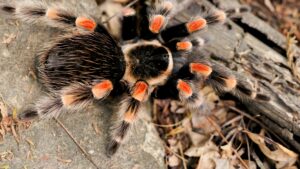
The photograph above is a reminder to be careful with colour from a single picture. Structural blue depends on how light hits the hairs, and Foelix and colleagues saw the colour of a single hair shift with the angle of the light.[1] This cobalt blue tarantula, photographed head on, looks nearly colourless. We did not measure it, so we cannot say how much of that is angle, lighting or the camera.
From tarantula hair to new materials
Because tarantula blue changes so little with viewing angle, it caught the interest of materials scientists. In 2017 Hsiung and colleagues used the flower-like cross-section of some blue tarantula hairs as a model for nano-3D-printed structures. Their structural colour kept its hue over a viewing angle of about 160 degrees.[9][11]
Blue tarantulas on our site
- Melopoeus lividus, the cobalt blue tarantula, filmed and photographed in Thailand in 2018, with its name history.
- Antikuna, a genus of Peruvian Andes tarantulas, several of them with blue or violet iridescence on the femora.
- Ewok cyaneolus, the cobalt red rump tarantula, formerly Thrixopelma cyaneolum.
- Harpactira pulchripes, the golden blue leg baboon tarantula from South Africa. Pocock’s 1901 description does not mention blue, so the hobby name comes from the living animal.
- Xenesthis and Pseudhapalopus “yellow blue”, two blue-toned Colombian finds.
For the family as a whole, see our Theraphosidae overview.
Short answers
Who discovered why tarantulas are blue?
Rainer Foelix, Bruno Erb and Benno Wullschleger published the first electron microscope study of blue tarantula hairs in 2009, in the German-language journal Arachne. They found layers of cuticle and air in the hair wall that reflect blue by interference.[1]
Why does a tarantula look less blue over time, and why do moults fade?
The blue is brightest right after a moult. Shed skins lose most of their blue within months, probably because the drying cuticle shrinks and the reflecting layers move closer together.[1]
Can tarantulas see their own blue?
Unknown. Their eyes are small and blurry, but a 2020 study found more opsin genes than expected, so colour vision can no longer be ruled out.[4][5]
Is blue a rare colour in tarantulas?
No. It is common, and green is the rare one. In 2015, 40 of 53 genera had a blue species and 12 had a green one. In 2020, 25 of 37 genera were scored as blue and 11 as green.[4][5]
References
- Foelix, R., Erb, B. & Wullschleger, B. (2009). Worauf beruht die Blaufärbung gewisser Vogelspinnenarten? Arachne 14(3): 4–12.
- Foelix, R., Rast, B., Erb, B. & Thieleczek, R. (2012). Zur blauen und gelben Färbung von Poecilotheria metallica (Pocock, 1899). Arachne 17: 4–9.
- Foelix, R. F., Erb, B. & Hill, D. E. (2013). Structural colors in spiders. In: Nentwig, W. (ed.), Spider Ecophysiology, pp. 333–347. Springer, Berlin. doi:10.1007/978-3-642-33989-9_24.
- Hsiung, B.-K., Deheyn, D. D., Shawkey, M. D. & Blackledge, T. A. (2015). Blue reflectance in tarantulas is evolutionarily conserved despite nanostructural diversity. Science Advances 1(10): e1500709. doi:10.1126/sciadv.1500709. Open access.
- Foley, S., Saranathan, V. & Piel, W. H. (2020). The evolution of coloration and opsins in tarantulas. Proceedings of the Royal Society B 287: 20201688. doi:10.1098/rspb.2020.1688.
- Simonis, P., Bay, A., Welch, V. L., Colomer, J.-F. & Vigneron, J. P. (2013). Cylindrical Bragg mirrors on leg segments of the male Bolivian blueleg tarantula Pamphobeteus antinous (Theraphosidae). Optics Express 21(6): 6979–6996.
- birdspidersCH, Cobalt Blue Tarantula – Haplopelma Tarantula Hunt in Thailand! (2018), at about 0:35 and at 2:03.
- birdspidersCH, Blue Golden Old World Tarantula – Summary & Overview (Harpactira pulchripes), at 10:02.
- Hsiung, B.-K., Siddique, R. H., Jiang, L., Liu, Y., Lu, Y., Shawkey, M. D. & Blackledge, T. A. (2017). Tarantula-inspired noniridescent photonics with long-range order. Advanced Optical Materials 5(2): 1600599. doi:10.1002/adom.201600599.
- Hsiung, B.-K., Shawkey, M. D. & Blackledge, T. A. (2019). Color production mechanisms in spiders. Journal of Arachnology 47(2): 165–180. doi:10.1636/JoA-S-18-022. A review for further reading.
- University of Akron (2017). Tarantulas inspire new structural color with the greatest viewing angle. Press release, via ScienceDaily, 7 February 2017.
- World Spider Catalog (2026). Natural History Museum Bern, checked 1 October 2026 for the species named here.