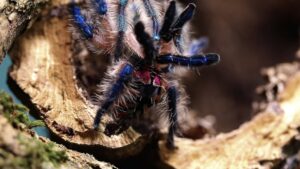
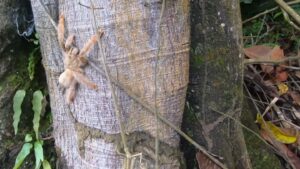
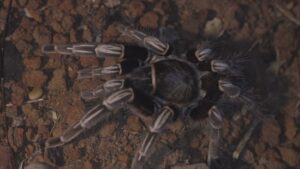
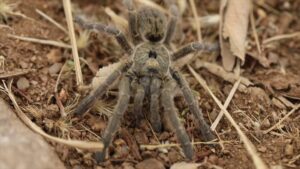
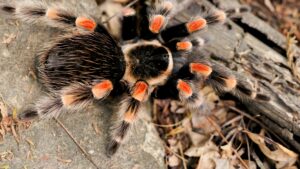
Xenesthis immanis (Ausserer, 1875) is a giant Colombian and Venezuelan tarantula and one of five accepted species in the genus Xenesthis.1 Its name is used more widely in the hobby than in the literature, because the genus was revised only in 2023 and its females look alike.2 This page sets out what the catalogue and the revision say about X. immanis and its relatives, and where our own films fit.
The five Xenesthis species
- X. avanzadora Sherwood et al., 2023, described from a single holotype male from Venezuela.1
- X. colombiana Simon, 1891, the type species, from Colombia.1
- X. immanis (Ausserer, 1875), Colombia and Venezuela.1
- X. intermedia Schiapelli & Gerschman, 1945, Venezuela.1
- X. monstrosa Pocock, 1903, listed by the catalogue as Colombia with a question mark.1
When we made our captive films in 2020 and 2021, we said on camera that only three Xenesthis species were described. The 2022 and 2023 papers changed that count: X. colombiana came back as a valid species and X. avanzadora was added.23
How the name immanis got tangled
In 1875 Ausserer described Lasiodora immanis from females. Pocock moved it to Xenesthis in 1901 and at the same time folded Simon’s X. colombiana, known from a male, into it, treating the male as the missing sex of Ausserer’s species. He gave no detailed reasons.2 For over a century nobody disputed that.
In 2022 Gabriel and Sherwood reversed it, citing leg measurements that do not fit one species and no written justification from Pocock, and they rejected the old Panama record for X. immanis as well.3 The 2023 revision then redescribed the old museum material. It designates a lectotype female for X. immanis from two syntype females, with a total length of 64.6 millimetres including the chelicerae, brown in alcohol.2
What separates X. immanis from its relatives
For females, the revision separates X. immanis from X. intermedia and X. monstrosa by the number of maxillary cuspules, 150 to 170 against 90 to 100 and 60 to 70. Leg IV against carapace length separates it from X. monstrosa: in X. immanis the leg exceeds three times the carapace.2 Colour plays no part in that diagnosis.
Open is the male. The jar holding the syntype females also contained a single male leg I and palp, but the authors could not be sure it belonged to the same species and did not describe a male for X. immanis.2 A male sold or filmed as X. immanis is therefore, for now, a hobby identification that the palp cannot confirm against a published male.
At genus level the diagnosis is clearer. Xenesthis has scopulae on the retrolateral side of metatarsus IV as well as underneath, which no other theraphosine genus has, and males carry two prolateral spermatic pores.2 The authors call the genus close to Pamphobeteus (see our page on Pamphobeteus ornatus) and note that scopula extent works for genera but not for separating species.2
Blue, White and the other hobby names
Several Xenesthis circulate in the hobby under informal names such as “Blue”, “White” and “Bright”. None of them is a described species, and the revision does not match them to one. In quotation marks they stay: Xenesthis sp. “Blue” and Xenesthis sp. “White”.
In the film on the Colombian blue animals we tell viewers that the extra scopula on metatarsus IV places it with X. immanis, while “White” and X. intermedia lack it (at 7:27 in the film). The revision calls the character a genus-level one, so read that as our hobby shorthand rather than a diagnostic key.
Our films
All three Xenesthis films are embedded on our page about the purple tarantula question and a nocturnal Xenesthis encounter. That is the page to open for the field footage.
Field, Colombia. In Xenesthis White Tarantula species found in Colombia (2018) a night drive along a road had turned up a few large Xenesthis, and we show an adult female of Xenesthis sp. “White” out of her burrow (at 3:18 in the film). The hobby name comes from the spiderlings, whose tarsi and metatarsi carry pale markings. For me it is the first wild Xenesthis I have seen. In the longer film on the blue animals the field part ends with rock piles in Colombia, where Xenesthis sp. “Blue” uses burrows beneath large rocks, and a torch that moves too fast sends the spider underground.
Captive, our collection. Biggest spiders caught on film: Xenesthis Edition (2021) follows captive giants, among them a pair we call X. immanis. We introduce the adult male to the adult female (at 5:43 in the film), and the female had built an egg sac before, for a previous owner. The mating is very friendly, with a well-fed female not angry at the male. Afterwards she walked back into her burrow, and we hoped for 25 to 70 spiderlings.
The same film shows how readily the genus flicks urticating hairs, so that young animals quickly have bald abdomens, and the typical defensive posture: legs spread, hind legs raised, abdomen pointing up. The film on the blue animals adds our own keeping notes. A captive-bred juvenile of Xenesthis sp. “Blue” is bolting and skittish and is fed lateralis roaches. Adult females live in 40 centimetre cube tanks, with a burrow temperature of about 22 to 23 degrees Celsius and 25 to almost 27 outside it in summer.
Where it lives
The catalogue gives Colombia and Venezuela for X. immanis.1 The earlier Panama record rests on the synonymy with X. colombiana and was rejected in 2022.3 The revision also stresses how little material exists: the genus is rare in museum collections, built on old and fragmentary specimens, and the authors call for more material and for the unknown sexes.2 The sites of our own Colombian films stay private.
Related pages
Another Colombian film, Cyriocosmus leetzi, shows a dwarf species from the same country. For the family and its subfamilies, start with the Theraphosidae overview.
References
- World Spider Catalog (2026). Xenesthis Simon, 1891. Natural History Museum Bern. Accessed 1 October 2026.
- Sherwood, D., Gabriel, R., Peñaherrera-R., P., Brescovit, A. D. & Lucas, S. M. (2023). On the tarantula genus Xenesthis Simon, 1891, with description of a new species from Venezuela. Taxonomy 3(4): 509-527. doi:10.3390/taxonomy3040029
- Gabriel, R. & Sherwood, D. (2022). Taxonomy, biogeography, and ecology of some theraphosid spiders of the Darién region with description of five new species. Revista Ibérica de Aracnología 40: 5-18.