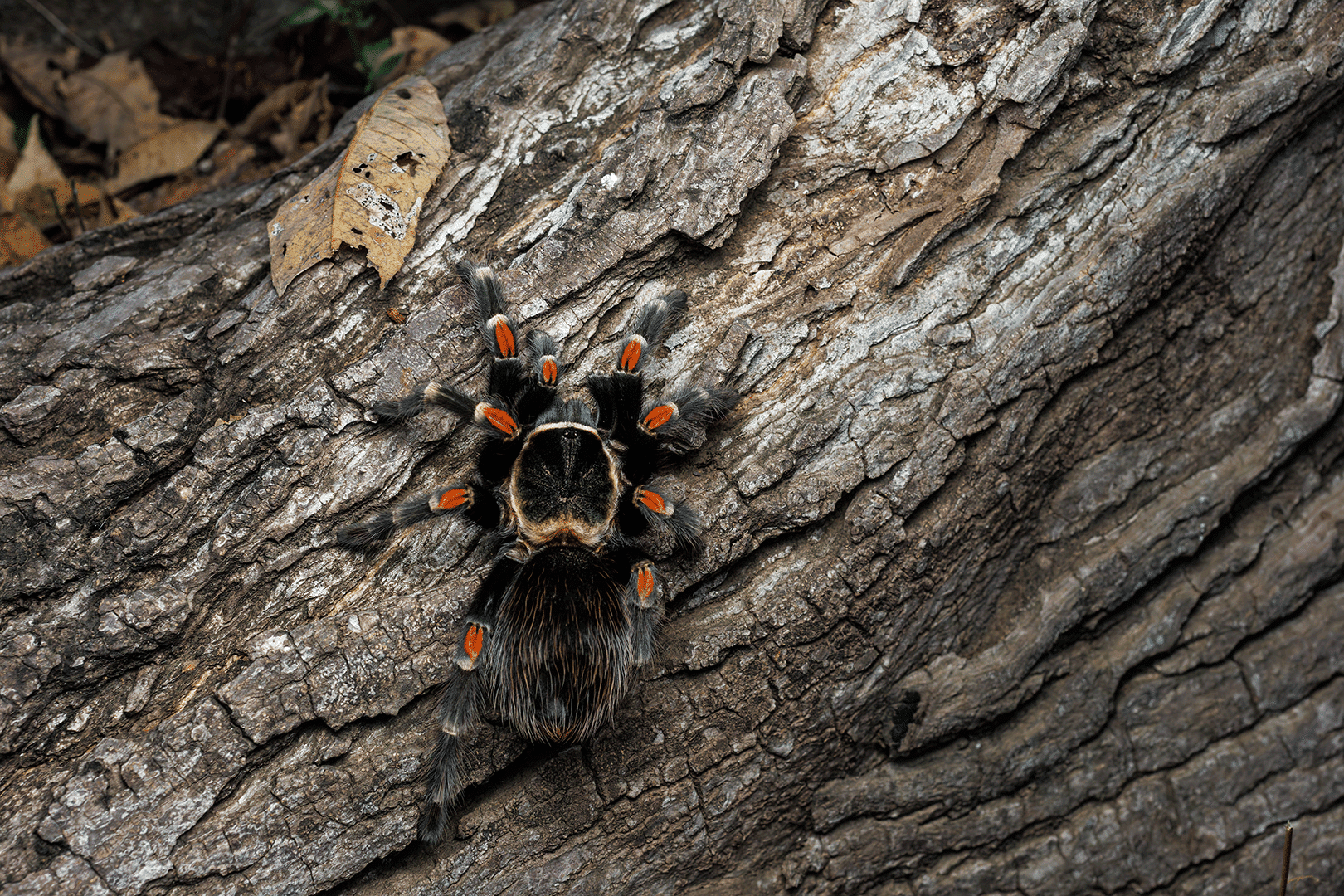
The story of Brachypelma auratum is one of those delightful collisions between the academic world and the underground network of exotic pet enthusiasts. And honestly? The spider doesn’t seem to care either way. It’s been doing its thing in the dry valleys of central Mexico for millions of years, long before anyone decided to give it a name or put it in a terrarium.
A Species That Skipped the Queue
Here’s the thing that makes B. auratum genuinely unusual: it was swimming in the pet trade before it officially existed in scientific literature. German arachnologist Günter Schmidt finally gave it a formal description in 1992, but collectors had been trading these flame-marked beauties for years before that, often labeling them as a “variant” of the more famous Brachypelma smithi (Schmidt, 1992).
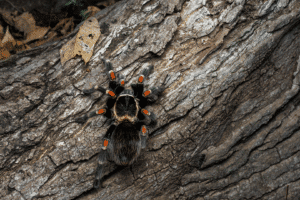
They weren’t entirely wrong to be confused. At first glance, several Mexican red-kneed tarantulas look similar enough to trip up even experienced keepers. But B. auratum has a calling card that’s impossible to miss once you know what to look for: those flame-shaped orange markings on its knees. Not bands. Not rings. Flames. Like someone took a tiny brush and painted tongues of fire against the velvet black of its legs.
The 2020 systematic revision by Jorge Mendoza and Oscar Francke confirmed what hobbyists had suspected all along—this spider is genetically and morphologically distinct from its cousins. The researchers noted that B. auratum “can be distinguished from all other known Brachypelma species by the coloration of the legs with red-orange flame-shape on patellae” (Mendoza & Francke, 2020). Sometimes science catches up to what the bedroom breeders already knew.
Anatomy of a Flame
Let’s talk about what makes this spider so visually striking, because the details are genuinely remarkable when you look closely.
Adult females reach about 60mm in body length, with males slightly smaller at around 45mm (CITES, 2021). That translates to roughly a 15cm leg span—about the size of your hand if you spread your fingers wide. Not the largest tarantula by any means, but substantial enough to command attention.
The carapace is predominantly black, bordered with buff or orange coloring. Some females display an interesting variation: a light brown area extending behind the fovea (that’s the central pit on top of the carapace), creating two distinct pattern morphs within the same species (Mendoza & Francke, 2020). It’s a reminder that even within a single species, nature likes to keep things interesting.
But the real showstopper is the leg coloration. Where Brachypelma hamorii—the more commonly seen Mexican Red Knee—wears orange bands across multiple leg segments, B. auratum keeps its flames contained. The patellae (knee segments) bear that signature orange flame shape, while the rest of the leg remains almost entirely black. There are subtle white rings at the joints, and if you catch them in the right light, the chelicerae (the fangs and surrounding structures) reveal a hidden Oxford blue sheen (Mendoza & Francke, 2020).
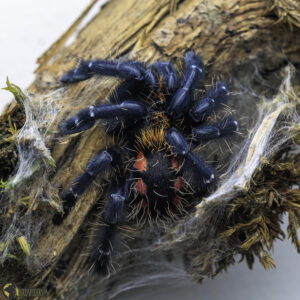
Scattered across the black abdomen, you’ll find sparse rose-colored hairs that catch the light like amber. It’s these small details—the blue-tinted fangs, the pink-tinged setae—that reward patient observation. This isn’t a spider you appreciate in a glance. It’s one that reveals itself slowly.
Home in the Hot Valley
Brachypelma auratum is endemic to Mexico, meaning it exists nowhere else on Earth. Its range is surprisingly specific: the Balsas River Basin, a hot, dry depression carved between mountain ranges in south-central Mexico. The species occurs mainly “north of the Sierra Madre del Sur and south of the Transverse Neovolcanic Ranges,” spanning parts of eastern Jalisco, southwestern Mexico State, northern Michoacán, and northwestern Guerrero (Mendoza & Francke, 2018).
This isn’t rainforest territory. The Balsas Depression features a tropical subhumid climate with a severe dry season that can last up to eight months. Annual precipitation stays below 1,200mm, and temperatures range from scorching to merely very warm (One Earth, 2020). It’s the kind of landscape where only the well-adapted survive.
The dominant vegetation includes deciduous dry thorn forest—trees that drop their leaves during the brutal dry season, thorny scrub that discourages casual browsers, and scattered cacti. The tarantulas make their homes at elevations between 600 and 1,600 meters above sea level, tucked into the landscape in ways that make them remarkably difficult to find (Mendoza & Francke, 2020).
The Hidden Architecture
Unlike some tarantula species that announce their presence with elaborate silk-lined burrow entrances, B. auratum practices discretion. Their burrows have no visible webbing at the entrance—no telltale silk doormats to give them away. They’re either excavating their own refuges or modifying existing cavities beneath large rocks and tree roots, always within the protection of thorny brush (Mendoza & Francke, 2020).
The burrow architecture itself is more sophisticated than a simple hole in the ground. A horizontal tunnel, often three times the spider’s body length, leads to a molting chamber. Beyond that, a shorter vertical passage drops into a resting chamber—their bedroom, dining room, and fortress against the world above.
This fossorial lifestyle (a fancy way of saying they live in burrows) is common among Brachypelma species, but the specific adaptations to the Balsas environment make B. auratum particularly interesting. The lack of silk at the entrance isn’t laziness—it’s likely an adaptation to the dry, dusty environment where visible webbing might actually attract unwanted attention rather than capturing prey.
A Decade in the Making
If there’s one thing tarantulas teach us, it’s patience. Brachypelma auratum lives life on an entirely different timescale than most animals we’re familiar with.
Males take seven to eight years to reach sexual maturity. Females need even longer—nine to ten years before they’re ready to breed. And then? A female might live another decade or more, potentially reaching ages of 20-25 years in captivity. Males, unfortunately, don’t share this longevity; they typically die within a year or two of their final molt.
The breeding season begins as the rainy season tapers off, running from August through January. Males, having completed their final molt and now sporting specialized structures called tibial hooks, emerge from their burrows and wander—sometimes in daylight—searching for the pheromone trails left by receptive females (Mendoza & Francke, 2020).
A female ready to mate adds silk to her burrow entrance, though this additional webbing isn’t visible to the naked human eye. If mating succeeds, she’ll produce an egg sac during the drier winter months, with spiderlings emerging and dispersing in late spring, just before the early summer rains arrive. Hundreds of tiny flame knees, scattering into the thorny landscape to begin their own decade-long journey to adulthood.
The Dinner Menu
As nocturnal predators, B. auratum employs an ambush strategy. They wait near their burrow entrances from dusk into the night, relying on vibration-sensitive hairs to detect approaching prey. Their diet consists primarily of ground-dwelling arthropods—beetles, crickets, grasshoppers, other arachnids, and centipedes.
But here’s where field observations get interesting. In areas where these tarantulas are found, researchers have noted abundant gecko and small lizard populations. The assumption? Wild B. auratum may consume more vertebrate prey than previously thought. Those powerful chelicerae, folding downward like pocket knives, deliver venom that’s harmless to humans but devastating to small reptiles—liquefying tissue and allowing the spider to consume its meal externally.
The Conservation Paradox
Now we arrive at the complicated part. Brachypelma auratum is listed under CITES Appendix II, meaning international trade is regulated and monitored. The IUCN assessed its status in 2018 and categorized it as Near Threatened (Fukushima et al., 2018). It’s not on the brink of extinction, but it’s not comfortable either.
The threats are familiar ones: habitat loss from agricultural expansion and cattle ranching, fragmentation of the dry forests they depend on, and yes, collection for the pet trade. In Mexico, wild populations of Brachypelma tarantulas are generally declining “due to habitat loss, because people often kill them when encountered in the wild and because large numbers of some of the more colourful species are collected” (Mendoza & Francke, 2020).
But here’s where the story takes an interesting turn. According to CITES trade data, between 2006 and 2016, approximately 1,000-1,059 live B. auratum were traded internationally. The remarkable detail? None were reported as wild-caught (CITES, 2018). Almost all were traded for commercial purposes—meaning captive-bred animals for the pet trade.
A recent analysis of CITES data revealed something hopeful: after Brachypelma species were listed under CITES protection, the supply shifted almost exclusively (over 99%) toward captive-bred specimens, despite a 330% increase in overall trade numbers (Herzig et al., 2023). Unlike some protected species where regulation simply drives trade underground, the tarantula hobby has largely transitioned to sustainable captive breeding.
This matters. It means the B. auratum you might purchase from a reputable breeder today almost certainly didn’t come from the wild. The hobby has, in effect, created a parallel population that takes pressure off wild animals. It’s not a perfect solution—captive breeding can’t fix habitat loss—but it’s a genuine conservation success story.
The scientific community has begun recognizing the value of hobbyist collaboration. Research on tarantula taxonomy, evolution, and even drug discovery has increasingly utilized specimens and data provided by dedicated keepers (Herzig et al., 2023). The arachnocultural community, when working under proper scientific supervision and with good locality data, has become an unexpected ally in conservation and research efforts. Captive breeding programs coordinated through organizations like the European Association of Zoos and Aquaria are beginning to incorporate hobbyist-maintained populations as genetic reservoirs for species threatened in the wild.
The Flame Knee vs. The Red Knee: Setting the Record Straight
One of the most common questions from both new and experienced keepers: what’s the difference between B. auratum and B. hamorii (the Mexican Orange Knee, often called Mexican Red Knee)?
The key is in the leg coloration. B. auratum has legs that are “entirely black except for the orange or red flame-shape in the center of the patellae” (Mendoza & Francke, 2018). No orange on the tibiae. No orange on the metatarsi. Just those contained flames on the knee segments.
B. hamorii, by contrast, wears orange or yellow bands across multiple leg segments—patella, tibia, and metatarsus all get the treatment. It’s a banded pattern versus a flame pattern. Once you’ve seen them side by side, you’ll never confuse them again.
Geographically, they’re also separated. B. auratum lives inland, in the Balsas Depression. B. hamorii ranges along the Pacific Coast. They don’t overlap in the wild—entirely different valleys, different microclimates, different evolutionary pressures that shaped them into distinct species.
Keeping the Flame Alive
For those considering B. auratum as a pet, the good news is that their care requirements are nearly identical to other Brachypelma species. They’re generally considered docile, slow-moving, and forgiving of minor husbandry mistakes—an excellent choice for beginners who want something more striking than the common species without venturing into challenging territory.
Temperature: 24-28°C (75-82°F), with some nighttime drop acceptable—even natural, given their highland origins.
Humidity: 60-70%, achieved primarily through a water dish and occasional light misting rather than swamp-like conditions.
Substrate: Deep (10-15cm) and diggable, mimicking their natural inclination to modify or excavate burrows. Coconut fiber mixed with organic soil works well.
Enclosure: Terrestrial setup with a secure hide. Given their wild preference for “privacy entrances,” a hide with a single small opening often encourages natural behavior.
One insight from wild observations: they don’t web their burrow entrances. If your captive specimen is heavily webbing everything, it might indicate stress or unsuitable conditions. A relaxed B. auratum keeps a clean doorstep.
The Sympatric Surprise
One of the more fascinating discoveries from field research involves B. auratum’s relationship with its cousin, Brachypelma albiceps. In certain locations within the Balsas region, these two species have been found living in remarkably close proximity—burrows just meters apart, sharing the same microhabitat.
This sympatric occurrence (species living in the same area without interbreeding) raises interesting questions about resource partitioning and ecological niches. How do two closely related tarantula species coexist in the same patch of thorny scrub without outcompeting each other? The answers likely involve subtle differences in burrow site selection, prey preferences, or activity timing that researchers are still working to understand.
For hobbyists, these observations carry practical implications. If two Brachypelma species can tolerate close proximity in the wild, it suggests something about their fundamental nature—perhaps a lower level of territorial aggression than we might assume. Of course, nobody’s suggesting you house them together in captivity. But understanding their natural spacing behaviors can inform how we think about enclosure placement and room sharing in collections.
Why This Spider Matters
It would be easy to dismiss Brachypelma auratum as “just another tarantula”—a pretty pet for enthusiasts, nothing more. But I think that misses something important.
This spider represents millions of years of evolution in a specific landscape. Every aspect of its biology—the camouflaged burrow entrance, the flame markings that may serve as warning coloration, the decade-long maturation period, the synchronization of breeding with seasonal rains—tells a story about adaptation and survival in the Balsas Depression.
When we keep them in captivity, we become custodians of that evolutionary heritage. When we breed them successfully, we participate in a kind of parallel conservation that, imperfectly but meaningfully, reduces pressure on wild populations. When we study them, we add to the body of knowledge that might one day protect their habitat.
The Mexican Flame Knee tarantula was keeping its secrets in the dry valleys of central Mexico long before any human gave it a name. With continued conservation efforts and responsible captive breeding, it’ll be there long after we’re gone—flames still burning against the black earth, waiting for whatever comes next.
References
- CITES. (2018). CITES Trade Database. United Nations Environment Programme World Conservation Monitoring Centre. Cambridge, UK.
- CITES Secretariat. (2021). Identification of CITES-listed Tarantulas: Aphonopelma, Brachypelma and Sericopelma. CITES Secretariat, Geneva, Switzerland.
- Commission for Environmental Cooperation (CEC). (2017). Sustainable Trade in Tarantulas: Action Plan for North America. Montreal, Canada.
- Fukushima, C.S., Mendoza, J., West, R.C., Longhorn, S.J., Rivera, E., Cooper, E.W.T., Hénaut, Y., Henriques, S., & Cardoso, P. (2018). Brachypelma auratum. The IUCN Red List of Threatened Species 2018.
- Herzig, V., King, G.F., & Bhola, R. (2023). Perspectives on the international trade in arachnids. Frontiers in Arachnid Science, 2, 1161383.
- Locht, A., Yáñez, M., & Vázquez, I. (1999). Distribution and natural history of Mexican species of Brachypelma and Brachypelmides (Theraphosidae, Theraphosinae) with morphological evidence for their synonymy. Journal of Arachnology, 27: 196-200.
- Mendoza, J., & Francke, O. (2017). Systematic revision of Brachypelma red-kneed tarantulas (Araneae: Theraphosidae), and the use of DNA barcodes to assist in the identification and conservation of CITES-listed species. Invertebrate Systematics, 31: 157-179.
- Mendoza, J., & Francke, O. (2020). Systematic revision of Brachypelma red-kneed tarantulas (Araneae: Theraphosidae), and the use of DNA barcodes to assist in the identification and conservation of CITES-listed species. Zoological Journal of the Linnean Society, 188: 82-147.
- One Earth. (2020). Balsas Dry Forests Ecoregion Profile. One Earth Foundation.
- Schmidt, G. (1992). Erstbeschreibung von Brachypelma auratum. Arachnologischer Anzeiger, 3: 9-14.