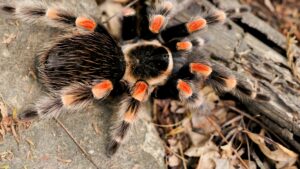
The cobalt blue tarantula is Melopoeus lividus (Smith, 1996), a burrowing tarantula with metallic blue legs from Myanmar and Thailand. It was formerly called Haplopelma lividum, and later Cyriopagopus lividus, and all three names refer to the same spider.
| Fact | Detail | Source |
|---|---|---|
| Accepted name | Melopoeus lividus (Smith, 1996) | World Spider Catalog, Version 27, accessed 2 October 2026 |
| Former names | Haplopelma lividum (original, Smith 1996); Cyriopagopus lividus (Smith & Jacobi, 2015) | World Spider Catalog; Smith 1996 |
| Range | Myanmar and Thailand, in Thailand as far south as Prachuap Khiri Khan province | World Spider Catalog; Hauke 2017 |
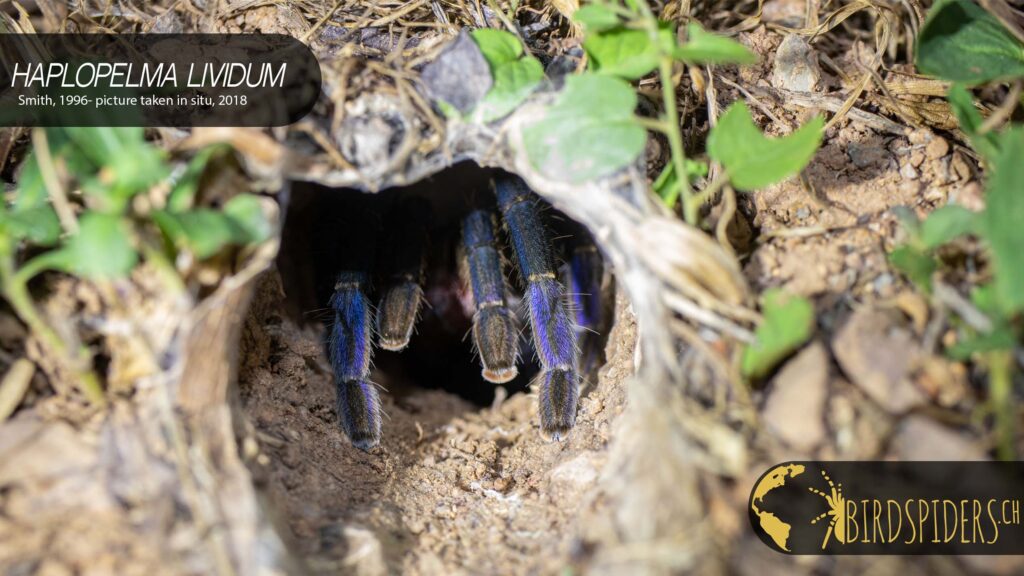
| Burrow | Silk-lined tube with a trumpet-shaped opening in loamy banks and between roots; we found them in ground burrows and roadside embankments | Smith 1996; Hauke 2017; our 2018 field record |
| Size on record | Carapace 22 mm in the male holotype and the dried female paratype; the description gives no leg span | Smith 1996 |
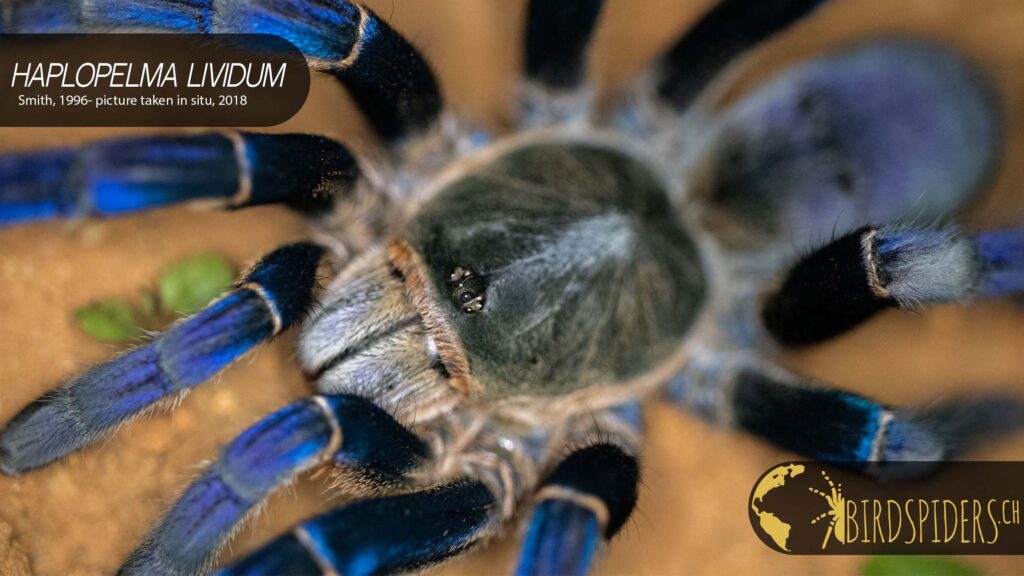
| Colour | Cobalt blue-purple iridescence on the legs; carapace black with grey-fawn hairs | Smith 1996 |
| Bite on record | Two finger bites in a Japanese report: local symptoms, and joint stiffness for a few weeks after one of them | Hauke 2017 |
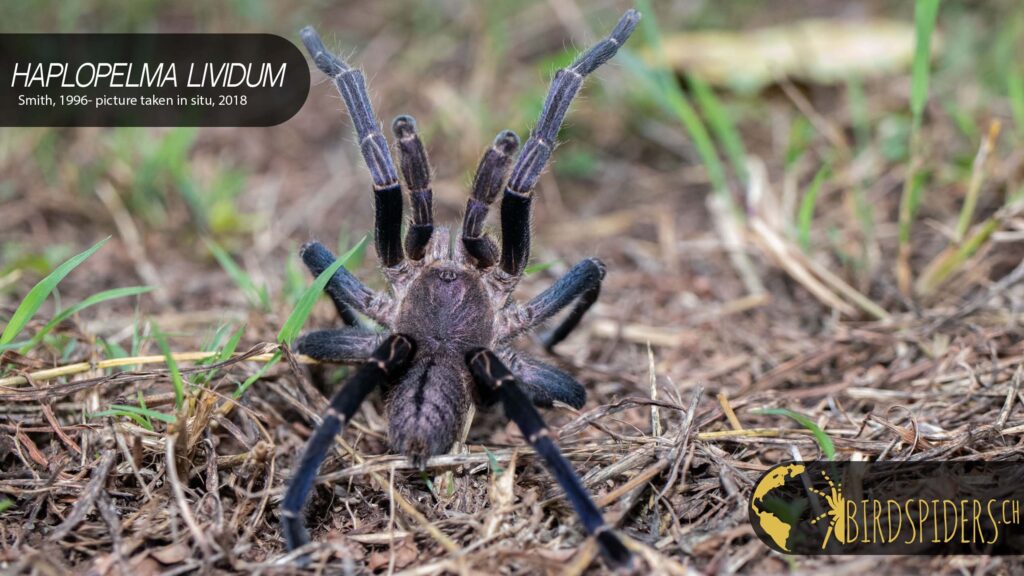
| Our observation | Thailand, 2018: an adult male in his burrow and an adult female in open grassland | Our field record |
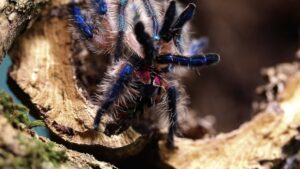
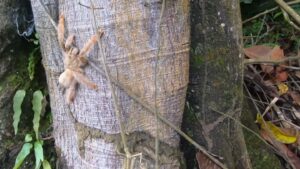
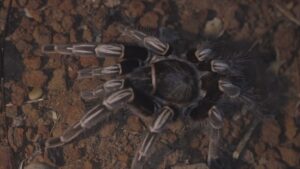
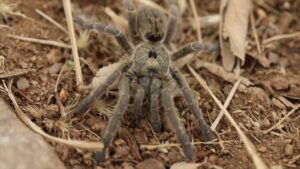
During our 2018 field trip in Thailand, we documented a male and a female cobalt blue tarantula. Both appeared brighter blue to us than the captive-bred animals we had seen. The field photographs and two videos below record the spiders and the habitat where we found them.
What is the scientific name of the cobalt blue tarantula?
Andrew Smith described the species as Haplopelma lividum in 1996, from a male holotype and three female paratypes collected in Burma. In 2015 Smith and Jacobi moved it to Cyriopagopus, and many pages still use that name or the older one. The World Spider Catalog now accepts Melopoeus lividus, following Smith, Daniel and Vignaud (2026). The change from lividum to lividus comes with that new combination, so a search for any of the three names leads to the same animal and the same taxonomic history.
The reason is the genus name Cyriopagopus. Its type specimen, a fragmentary juvenile from Tavoy, cannot be found and is deemed lost, so the catalog now treats the genus name as a nomen dubium and restores Melopoeus as a valid genus, although it gives only the family Theraphosidae and no current subfamily for this species. Smith, Daniel and Vignaud, 2026; WSC genus record
What does a wild cobalt blue tarantula look like?
Smith’s description names the cobalt blue colour in both sexes. In the male the legs are velvet black to slate grey, with a cobalt blue-purple iridescence on the upper and front faces of the leg segments of legs I and IV. The carapace is black with grey-fawn hairs and the abdomen is black. In the female the blue is stronger on legs I to III, while leg IV tends to stay black with only fragments of iridescence. Both descriptions come from preserved specimens, and the carapace measured 22 mm in the male holotype and in the dried female paratype that Smith described.
In Thailand, both spiders looked brighter blue to us than the captive-bred animals we had seen, which is an impression and not a measurement, and iridescent colour also shifts with angle and light: one photograph below shows the same species reading brown in a defensive posture.
Where do cobalt blue tarantulas live in the wild?
The World Spider Catalog records Melopoeus lividus from Myanmar and Thailand only. Smith gave the Tenasserim region of Burma, with collecting areas on the Thai frontier, and Hauke (2017) reports that the species has been found repeatedly in Thailand in recent years, as far south as Prachuap Khiri Khan province. Some pages add Laos, Cambodia or Vietnam, but the catalog does not.
Our 2018 spiders come from Thailand, and one encounter with its surroundings shows only where we filmed and photographed, not the whole range or every habitat within it.
Where do cobalt blue tarantulas burrow?
Smith describes a silk-lined tube with a trumpet-shaped silk opening in the ground. It is often found in loamy banks and between tree roots, and collectors have reported burrows in grassy clearings. In Thailand we found these spiders in burrows in the ground and in roadside embankments, while Hauke (2017) includes photographs of habitat and burrow entrances from southern Thailand that another observer took.
Two encounters are what we saw, and they do not show that every cobalt blue tarantula burrows in the same way, whatever the ground or the season.
In this short clip we talk about two ways of housing cobalt blue tarantulas: a planted roadside-embankment enclosure that recalls their habitat, and the classic space-saving setup preferred by breeders.
Our 2018 field record
In the two films below we search the forest in Thailand, find an adult male in his burrow, and later an adult female in open grassland, with close-up macro footage of each.
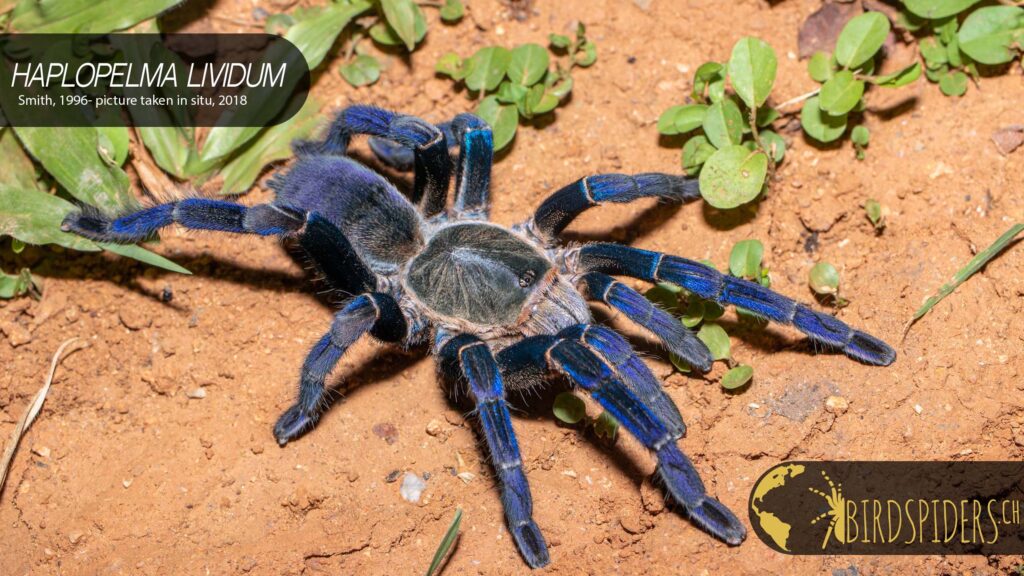
Male
Female
Photographs of the spiders
These are our own photographs from the same Thai field record. They show the animals in and around their burrows rather than in a container.


Are cobalt blue tarantulas dangerous?
Documented bites are few. Hauke (2017) summarises a Japanese report of two finger bites by this species, in which only local symptoms appeared and they faded within hours with symptomatic treatment, while one of the two bites also left joint stiffness that lasted a few weeks and then disappeared. The report’s authors concluded that the species is relatively harmless to humans.
Two cases are too few to call any tarantula safe, and Hauke notes that the venom of this group has been studied very little in humans.
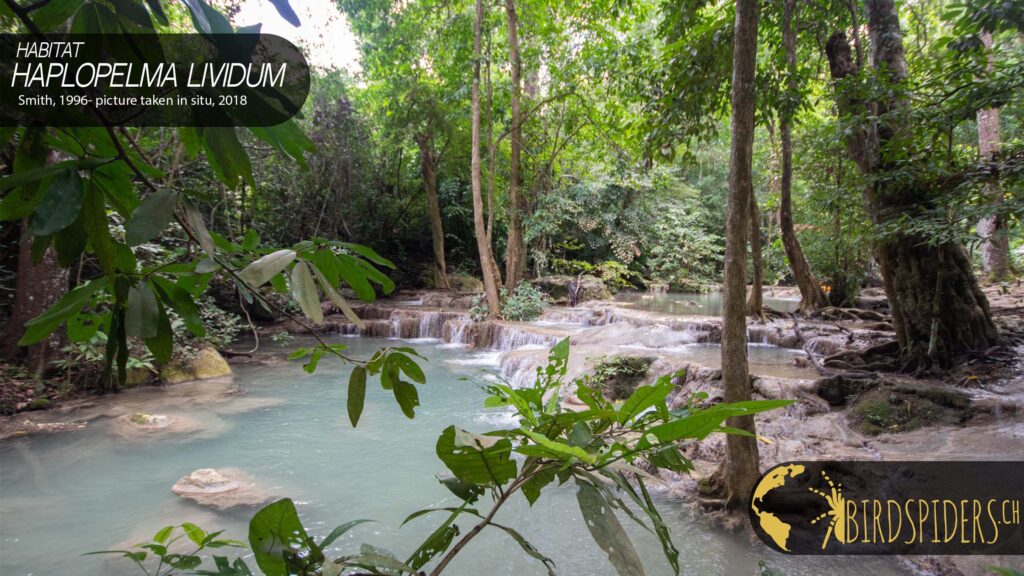
Habitat photographs
These photographs record one place at one time: the wet forest, watercourses, roadside banks and ground around the burrows.
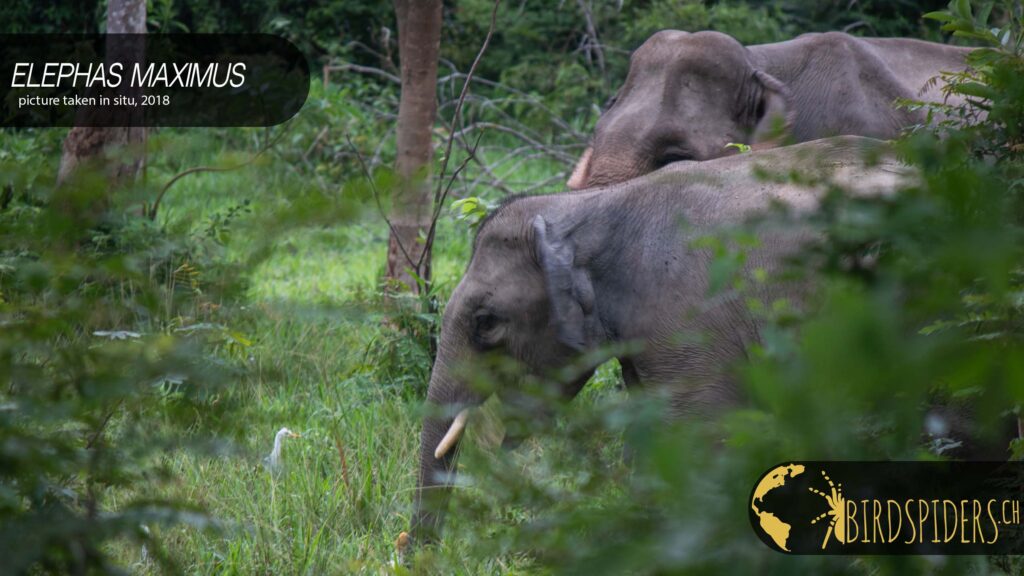
For another firsthand field account, read our Trinidad Chevron tarantula story, while the Ornithoctoninae gallery places this species beside related Asian tarantulas.
Aspinochilus rufus from Java is another Southeast Asian ornithoctonine that received its scientific name in a 2024 description.
Changing genus names are not unique to this species: our Omothymus spider page traces how an older genus label and a trade name became attached to the same Asian tarantula.
References
- World Spider Catalog. 2026. Melopoeus lividus (Smith, 1996), accepted species record. Natural History Museum Bern. https://wsc.nmbe.ch/spec-data/44094
- Smith, A. M., Daniel, B. A. and Vignaud, B. 2026. Nomenclatural notes on the Ornithoctoninae genera Cyriopagopus, Haplopelma and Melopoeus, with the intention of restoring the genera Haplopelma and Melopoeus. Journal of the British Tarantula Society 40(3): 15-28. WSC bibliography record
- World Spider Catalog. 2026. Cyriopagopus Simon, 1887, genus record. current catalog treatment
- Smith, A. M. 1996. A new species of Haplopelma (Araneae: Theraphosidae), with notes on two close relatives. Mygalomorph 1: 21-32.
- Hauke, T. 2017. Die Vogelspinnen der Gattungen Haplopelma Simon, 1892 und Ornithoctonus Pocock, 1892 (Araneae, Theraphosidae, Ornithoctoninae): Anmerkungen zur Taxonomie, Verbreitung, Ökologie und Bedeutung für den Menschen. Arachne 22(5): 4-53.
- World Spider Catalog. 2026. Version 27. Natural History Museum Bern. doi:10.24436/2