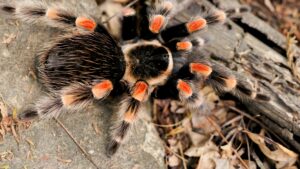
Which tarantulas really look purple?
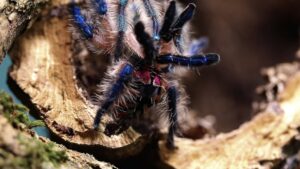
Although a purple tarantula is real, “purple tarantula” is not a species name; the clearest published example is a mature male Pamphobeteus antinous, with blue-violet iridescent bristles on parts of the legs and pedipalps. Pamphobeteus verdolaga has recorded violet overtones, while a Singapore field record describes violet-blue females and juveniles of Omothymus violaceopes. Those are the careful answers to the purple tarantula question.
Even when a spider carries one of those names, purple is not guaranteed: tarantula colour can be angle-dependent, limited to certain setae, and different between sexes or life stages. Useful as a detail to notice, colour cannot identify a tarantula from one photograph. For that reason, this page begins with the colour question, then returns to the blue-toned Xenesthis we met at night in Colombia, where the camera showed the same problem in the field.
The best-documented violet effect
In the optical study of P. antinous, a mature male had blue-violet setae on the dorsal leg segments and pedipalps that changed from blue to violet as the viewing angle increased, then faded; the effect comes from specialised bristles with a curved, layered structure, not a fixed purple pigment. That is the strongest reason to call a tarantula violet, and also the strongest warning against treating a still image as a colour chart.
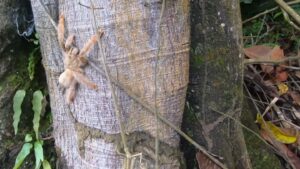
My friend Chris took me to a colony of Pamphobeteus ornatus in Colombia (2:06 in our Colombia film).
This BirdspidersCH film is labelled Pamphobeteus ornatus, not P. antinous. It belongs here as field footage of the same genus, not as proof that every Pamphobeteus is purple.
For P. verdolaga, the original description calls the genus usually dark with violet shades and records violet overtones on the front of the living male carapace; the animal was brown overall, so a violet component is real evidence but not the same thing as a uniformly purple spider.
In the Singapore field record, O. violaceopes is violet-blue in adult females and juveniles but brown in mature males; by contrast, the blue-violet P. antinous study was of a mature male. A broader study of structural blue in tarantulas also reports examples that lose blue at the moult to adulthood (Hsiung et al. 2015) [4]. In the species Foelix and colleagues examined, the bright colours sit in specialised hairs, not in the body cuticle, and come from light interference rather than pigment, and they list Pamphobeteus and Xenesthis immanis among the iridescent theraphosids (Foelix, Erb & Hill 2013) [3][5]. Our page on why tarantulas are blue covers those structures in more detail. That does not prove the same change in every violet-tinted species, but it shows why a colour label needs a life-stage label as well.
Colour is a lead, not an identification
Measured under stated viewing conditions in the P. antinous study, the purple reflection is not false, but the observation has a boundary: a photograph may record the violet moment, the blue moment or neither, depending on how the spider, light and camera meet. A species name needs evidence that survives that change.
Common names are doing more work than the science can support when they become an identification. “Purple tarantula” can help a reader find a likely group, but it is broader than a published description and much broader than a diagnosis. The 2023 Xenesthis revision separates males by palpal-bulb characters and females by maxillary cuspule counts and the length of leg IV; scopulae on the retrolateral and retrolatero-dorsal faces of metatarsus IV distinguish the genus from other theraphosines. Colour does not replace those characters.
Different sources answer different questions: the World Spider Catalog tells us whether a published name is accepted, the optical study tells us how the blue-violet effect behaved in one mature male, and the original description of P. verdolaga records the colour of its living male. None turns a common colour word into a diagnosis.
For that reason, the evidence supports three accepted species with documented violet or violet-blue appearance in defined circumstances, but it does not support turning every blue, pink or purple-looking tarantula into a species list. Although the honest answer may be less tidy than a care-sheet list, it gives the reader a better way to look at the animal.
Where the Colombian Xenesthis fits
Purple and pink searches often lead people to Xenesthis, and that is where this post has something a care sheet cannot offer: a nocturnal encounter with the animal in front of us. Although the blue tone in the photographs was visible under torchlight, colour did not settle its identity. The World Spider Catalog accepts five Xenesthis species, while the 2023 revision shows how old museum type material, a lost type and species known from only one sex make the genus difficult to resolve; the spiders in this post therefore remain Xenesthis sp. “Blue”, an informal field label.
For that reason, the revision distinguishes species with features such as the palpal bulb, maxillary cuspule counts and leg length, not with a purple or blue reflection; a photograph can show a spider at a retreat entrance and record the changing light around it, but it cannot replace diagnostic material.
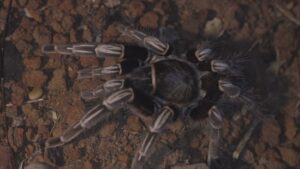
The title of this film says Xenesthis, and its catalogue description includes X. immanis. Treat that as the creator’s label, not a taxonomic identification. The film earns its place here because it shows the genus in the field, with soil, shadows and movement around the spider rather than a studio-lit colour swatch.
Commonly confused with purple
Blue is the nearest common confusion. The cobalt blue tarantula, Melopoeus lividus, is a useful contrast. It was described as Haplopelma lividum, but Melopoeus lividus is the accepted name. Its blue colour does not make it a purple species.
For the wider family, see the Theraphosidae overview, without a subfamily claim for Xenesthis, and compare photographs in the Tarantula Gallery. Neither is a colour key. They are a better starting point than a trade label when a purple-looking tarantula needs a closer look.
Torchlight and a fast retreat
At night, large blue-toned tarantulas sat at the mouths of deep retreats beneath rocks; because even weak torchlight often sent them underground, we learned to keep the beam brief, frame the photograph, and let the spider settle again.
Several sizes, one private site
Within the same broader area, we saw spiders of different sizes, but the exact locality remains private. The photographs show color and retreat position, while the video keeps the sequence of the encounter.
A field label, not a species
Xenesthis sp. “Blue” is an informal label. The World Spider Catalog accepts five named species in Xenesthis, including species recorded from Colombia, but none is called “Blue” [1]. A 2023 paper redescribed several species and added X. avanzadora from Venezuela [2]. The Colombian animals shown here have not been matched to a named species through diagnostic material.
The blue spiders at night


A white Xenesthis in Colombia
The Colombian series continues with Xenesthis sp. “White”, another informal field label. The genus is known for its shy behaviour and unusual colouring for such large spiders.
Continue exploring
Notes from the field, by email
I send a short tarantula briefing by email, with field notes from our trips written for the newsletter when I have them, and once a month a roundup of new posts. It is free, and you can unsubscribe at any time.
Later, if you want to support the fieldwork and the films, I am also on Patreon.
References
- [1] World Spider Catalog (2026). World Spider Catalog, version 27. Natural History Museum Bern. Xenesthis genus record. doi:10.24436/2.
- [2] Sherwood, D., Gabriel, R., Peñaherrera-R., P., Brescovit, A. D. & Lucas, S. M. (2023). On the tarantula genus Xenesthis, with description of a new species from Venezuela. Taxonomy 3(4): 509-527. doi:10.3390/taxonomy3040029.
- [3] Foelix, R. F., Erb, B. & Hill, D. E. (2013). Structural colors in spiders. In: Nentwig, W. (ed.), Spider Ecophysiology. Springer, Berlin, Heidelberg, pp. 333–347.
- [4] Hsiung, B.-K., Deheyn, D. D., Shawkey, M. D. & Blackledge, T. A. (2015). Blue reflectance in tarantulas is evolutionarily conserved despite nanostructural diversity. Science Advances 1(10): e1500709.
- [5] Foelix, R., Erb, B. & Wullschleger, B. (2009). Worauf beruht die Blaufärbung gewisser Vogelspinnenarten? Arachne 14(3): 4–12.