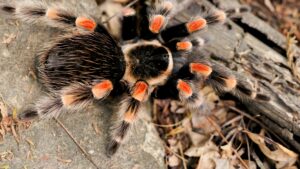
Grammostola iheringi (Keyserling, 1891), called the Entre Rios tarantula in the hobby, is a mid-sized to large tarantula from southern Brazil and Uruguay. Keyserling’s female measured 57 mm in body length. Similar Grammostola species are separated by their genitalia, not by size or colour. [1][4][5]

| Accepted name | Grammostola iheringi (Keyserling, 1891) [1] |
|---|---|
| Original name | Eurypelma iheringii Keyserling, 1891, both sexes described [1] |
| Synonym | Grammostola gigantea Mello-Leitão, 1921, placed in synonymy by Bücherl (1951) [1][5] |
| Hobby name | Entre Rios tarantula |
| Distribution | Brazil and Uruguay [1]. In Brazil: Rio Grande do Sul, Santa Catarina and Paraná [5]. In Uruguay: a restricted area, one department [6][7] |
| Body length | Male 47 mm, female 57 mm (Keyserling); females 57 to 66 mm in Schmidt’s key [3][4][5] |
| Legs | Weak greyish-yellow stripes on patellae and tibiae [5] |
| Urticating hairs | An apple-shaped patch with a metallic sheen [6] |
How big does Grammostola iheringi get?
Size figures in the taxonomic literature are usually body lengths, which leave out the legs, so they cannot be compared with leg-span numbers. Keyserling described both sexes in 1891 [1]. His male measured 47 mm and his female 57 mm [4]. Schmidt agrees [3]. Schmidt’s identification key gives females as 57 to 66 mm [5]. That makes it mid-sized to large. It stays well short of the golden-striped Grammostola aureostriata, whose females can pass 80 mm [3] [5]. That name is now treated as a junior synonym of Grammostola pulchripes (Simon, 1891) [9].
What does Grammostola iheringi look like?
Schmidt describes the legs of G. iheringi as carrying only weak greyish-yellow stripes along the patellae and tibiae, whereas Grammostola aureostriata (now treated as G. pulchripes [9]), from Paraguay and northern Argentina, wears conspicuous golden stripes on the same segments [5]. Beyond that pair, colour is limited. In a key to the mygalomorph spiders of Uruguay, G. iheringi is separated from G. mollicoma (now a junior synonym of G. anthracina [10]) by its urticating hairs, which sit in an apple-shaped patch with a metallic sheen [6].
How do I tell Grammostola iheringi from G. actaeon and other Grammostola?
Body size is a poor guide, since the group spans everything from about 40 mm to more than 80 mm [5]. The genitalia decide it. Females of the G. iheringi group have strongly curved spermathecae, and males carry a long black spine pressed against the smaller of the two tibial apophyses [5]. Grammostola actaeon is a separate species: its spermathecae curve less and it lacks that spine [5]. A 2016 study of Uruguayan Grammostola compared it with G. rosea, G. pulchra and other species, and describes male G. iheringi as having a spine on the inner side of the prolateral branch of the tibial apophysis and a mega-spine at the tip of the retrolateral side of tibia I [7].
Names need care. Some older records filed under G. iheringi were later moved to Grammostola chalcothrix, a species described from Argentina, so check the identification behind any older record or label, especially one that puts G. iheringi outside Brazil and Uruguay [8]. Grammostola rosea is a different species again, covered in our article on what the name Grammostola rosea means.
Where does Grammostola iheringi live?
The World Spider Catalog records G. iheringi from Brazil and Uruguay [1]. In Brazil the literature places it in the southern states of Rio Grande do Sul, Santa Catarina and Paraná [5]. Uruguay is the other country. There it occupies only a restricted area, a single department according to the 2009 Uruguayan key [6] [7]. The catalog lists no record from Argentina or Paraguay, where its relative G. aureostriata (now G. pulchripes) lives [1] [5].
Why is it called the Entre Rios tarantula?
The name does not match the range. Entre Ríos is a province of Argentina, and the catalog lists no Argentine record for G. iheringi [1]. The origin of the hobby name is not documented.
What did the GiTx1 venom study find?
A 2020 study isolated a peptide named GiTx1 from the venom of G. iheringi and tested its activity on voltage-gated ion channels. This was a laboratory study of a venom component. It does not justify a broad claim that a bite is harmless or dangerous to people [2]. For what documented tarantula bites do, see what tarantula venom does after documented bites.
For another Brazilian species, see our Acanthoscurria geniculata profile.
References
- World Spider Catalog: Grammostola iheringi.
- Montandon, G. G. et al. (2020). GiTx1, a novel toxin from the venom of Grammostola iheringi. Biochimie.
- Schmidt, G. (2005). Das Weibchen von Grammostola aureostriata Schmidt & Bullmer, 2001 (Araneae: Theraphosidae: Theraphosinae). Tarantulas of the World 106: 3-6.
- Peters, H.-J. (2000). Tarantulas of the World: Kleiner Atlas der Vogelspinnen, Band 1. Published by the author, Wegberg, Germany.
- Schmidt, G. (2001). Grammostola fossor sp. n., ein weiterer Vertreter der Grammostola iheringi-Gruppe aus Argentinien (Araneae: Theraphosidae: Theraphosinae). Arthropoda 9(3): 2-8.
- Montes de Oca, L. & Pérez-Miles, F. (2009). Las arañas Mygalomorphae del Uruguay: clave para familias, géneros y especies. Revista del Laboratorio Tecnológico del Uruguay 4: 41-49.
- Montes de Oca, L., D’Elía, G. & Pérez-Miles, F. (2016). An integrative approach for species delimitation in the spider genus Grammostola (Theraphosidae, Mygalomorphae). Zoologica Scripta 45(3): 322-333.
- Ferretti, N., Pompozzi, G., González, A. & Pérez-Miles, F. (2013). The genus Grammostola Simon 1892 (Araneae: Theraphosidae): a new species from western Argentina, new synonymy and distributional data. Journal of Natural History 47(47-48): 2961-2977.
- Gabriel, R. (2009). Notes on the taxonomic placement of Eurypelma borellii (Simon 1897), and Grammostola pulchripes Simon, 1892 (Araneae: Theraphosidae). Exotiske Insekter 73: 7-13.
- Fukushima, C. S., Pérez-Miles, F. & Bertani, R. (2011). On the Avicularia (Araneae: Theraphosidae: Aviculariinae) species from Uruguay. The Journal of Arachnology 39: 528-532.