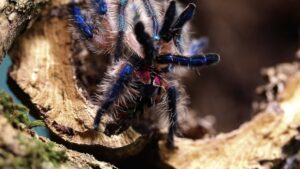
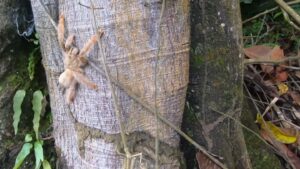
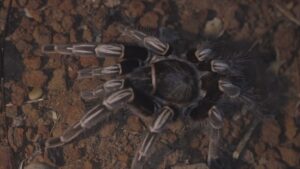
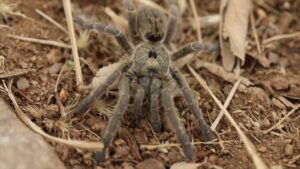
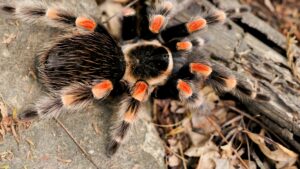
Ornithoctonus aureotibialis, the Thai golden fringe tarantula, is a large burrowing tarantula from Thailand. Volker von Wirth and Boris Striffler described it in 2005, and the World Spider Catalog accepts the name. The species name means “golden shin”, after a gold-orange fringe of hairs on the front legs. Before 2005 the trade sold it as Haplopelma sp. “aureopilosum”. We went looking for it in southern Thailand in 2018 and filmed two burrows in the rainy season.[1][2]
Which names does this tarantula go by?
- Ornithoctonus aureotibialis von Wirth & Striffler, 2005: the accepted name in the World Spider Catalog. Distribution listed: Thailand.[1]
- Haplopelma sp. “aureopilosum”: the pet-trade name used for years before the description. It was never published with a description.[2]
- Haplopelma chrysothrix Schmidt & Samm, 2005: a name published in the same year. The catalog treats it as a nomen nudum, because the authors cited no place where the type specimen is kept, and lists it under O. aureotibialis.[1][2]
- Thai golden fringe tarantula, Thailand golden fringe: common names, and the one we use in our film.
What is Ornithoctonus aureotibialis?
Ornithoctonus Pocock, 1892 holds three accepted species: O. andersoni from Myanmar, and O. aureotibialis and O. costalis from Thailand.[1] The golden fringe is the quickest way to tell O. aureotibialis from its two relatives. It runs along the outer side of the patella and tibia of legs I and II, and the describers named the species after it.[2]

Females are the big ones, 5 to 6 cm in body length, and dark overall with blackish legs. Males are smaller at 3.5 to 4.5 cm, and adult males look different: pale beige on top, with black femora, palps and tarsi. On the abdomen of both sexes the authors describe a faint pattern of dark strokes, which they call a herringbone pattern.[2] The fringe shows on subadults and adult females, and on subadult males. The fringe can fade in old females. Hauke notes that the species has been confused with a similar, undescribed Ornithoctonus from Thailand that lacks the fringe.[4]

Where does it live?
The catalog gives Thailand and nothing finer.[1] The type series came from several parts of the country.[2] Hauke describes the range as running roughly from the Bangkok area in central Thailand down to the south.[4] Like the other species of Haplopelma and Ornithoctonus he reviewed, it lives in a tube-shaped burrow in the ground. In the rainy season, he writes, these spiders can be seen at the burrow entrance even by day.[4]
Looking for the Thai golden fringe in the rain
Field footage from southern Thailand, 2018. We searched a national park for O. aureotibialis in August, in the rainy season, and I tell the history of the name on the way. About five years earlier I had searched for it in March, in the dry season, and found nothing, because the soil was rock hard. This time the burrows were easy to recognise, big and well built, with leaves around the entrance. We found one, filmed into the hole and failed to bring the spider out, then found a second, much larger burrow and tickled out an adult female for close-up shots. She is extremely big, most likely the biggest tarantula in that area, since the Chilobrachys species and the other Selenocosminae there do not grow that large, and I had wanted to find this species for years. Inside the park nothing may be disturbed, so we do not dig, we only tickle, photograph and let the spider go back in. The first burrow is at about 07:07 in the film.[5]

The species also closes a later film of ours. From 08:14, the closing segment of Malaysian Earth Tiger: The Tarantula Renamed 3 Times (Omothymus) AND Electric Blue Tarantula Bonus shows the species in the wild in Thailand, found while we were failing to find the electric blue tarantula. The rest of that film is on our Malaysian earth tiger page. A short clip of the species is on our Malaysia and Thailand hub, with the rest of the films from that region.
Two names in one year
Two German groups worked on this spider at the same time. Schmidt and Samm published it as Haplopelma chrysothrix in Tarantulas of the World. In the same year von Wirth and Striffler described it as Ornithoctonus aureotibialis in Arthropoda, in a paper that also described Haplopelma longipes and gave new diagnoses for both genera. They argue that the Schmidt and Samm name is not available under the zoological code and say von Wirth had been studying the species for years.[2][3] In our film I put it simply: two arachnologists were working on the same species, and the description came in 2005.
More from the same Thailand trip
Our cobalt blue tarantula page covers another Thai species. For the family as a whole, see the Theraphosidae overview.
References
- World Spider Catalog (2026), Ornithoctonus aureotibialis von Wirth & Striffler, 2005 and genus page Ornithoctonus. Natural History Museum Bern.
- Wirth, V. von & Striffler, B. F. (2005). Neue Erkenntnisse zur Vogelspinnen-Unterfamilie Ornithoctoninae, mit Beschreibung von Ornithoctonus aureotibialis sp. n. und Haplopelma longipes sp. n. (Araneae, Theraphosidae). Arthropoda 13(2): 2–27.
- Schmidt, G. & Samm, R. (2005). Haplopelma chrysothrix sp. n. (Araneae: Theraphosidae: Ornithoctoninae), eine seit 1989 dokumentierte, aber bis heute unbeschriebene Spezies aus Südostasien. Tarantulas of the World 107: 3–14. Cited as listed by the World Spider Catalog.
- Hauke, T. (2017). Die Vogelspinnen der Gattungen Haplopelma Simon, 1892 und Ornithoctonus Pocock, 1892 (Araneae, Theraphosidae, Ornithoctoninae): Anmerkungen zur Taxonomie, Verbreitung, Ökologie und Bedeutung für den Menschen. Arachne 22(5): 4–53.
- birdspidersCH on YouTube: Thai Golden Fringe Tarantula in the wild | Ornithoctonus aureotibialis (2018).
Related Images:

![Cyriopagopus cf doriae (Thorell, 1890)], female, Brunei, Sabah, Sarawak - Borneo](https://birdspiders.ch/wp-content/gallery/theraphosidae/Cyriopagopus-cf-doriae-Thorell-1890-female-Brunei-Sabah-Sarawak-Borneo.jpg?t=1673691486 "Cyriopagopus cf doriae (Thorell, 1890)], female, Brunei, Sabah, Sarawak - Borneo")